Maximizing Your Savings: Choosing Between a CD and a High-Yield Savings Account for Your $10,000 Investment
Posted 9/18/2026 3:06PM ET read more Yahoo Finance
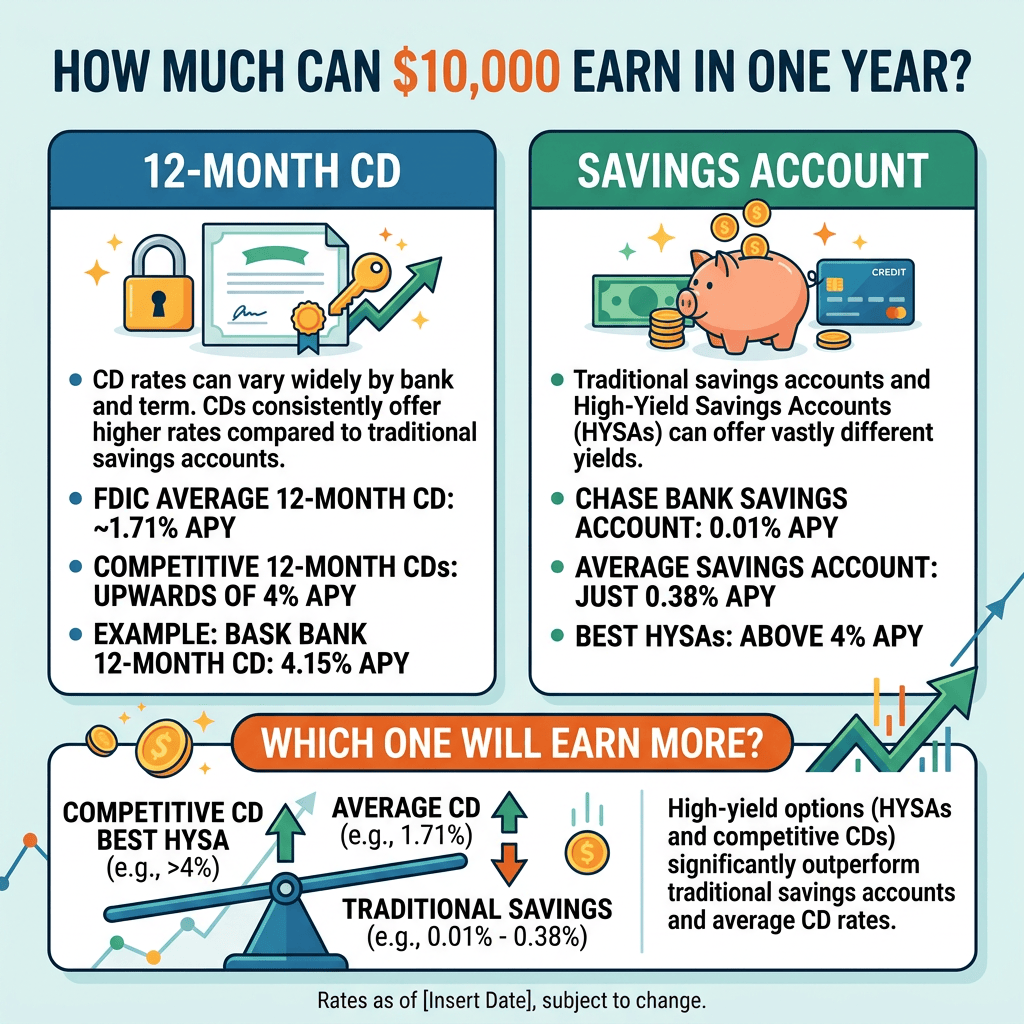
When considering where to park your money, the choice between a Certificate of Deposit (CD) and a savings account can significantly impact your earnings. If you invest $10,000 in a 12-month CD, current average rates hover around 1.71% APY, according to the FDIC. However, if you seek competitive options, banks like Bask Bank offer rates as high as 4.15% APY, allowing you to earn more over a year.
In contrast, traditional savings accounts typically yield much less. The average APY for these accounts is just 0.38%, with institutions like Chase Bank offering a meager 0.01% APY. On the other hand, some high-yield savings accounts (HYSAs) can outperform CDs, with rates exceeding 4% APY.
Ultimately, the choice between a CD and a savings account depends on your financial goals and willingness to lock in your funds for a specific term.
Investing $10,000: CD vs. High-Yield Savings Account
When deciding how to invest $10,000, two popular options are a Certificate of Deposit (CD) and a high-yield savings account (HYSA). Understanding how much you can earn from each can guide your decision on where to allocate your funds.
Earnings from a Certificate of Deposit (CD)
CDs are time deposits that typically offer higher interest rates than traditional savings accounts. The current average annual percentage yield (APY) for a 12-month CD is about 1.71%, according to the Federal Deposit Insurance Corporation (FDIC). This means if you invest $10,000 in a 12-month CD at this average rate, your earnings would be:
- Interest Earned = Principal × APY
- Interest Earned = $10,000 × 1.71%
- Interest Earned = $171
Therefore, your total balance at the end of the year would be approximately $10,171.
However, some of the most competitive 12-month CDs are currently available with rates upwards of 4%. For instance, Bask Bank offers a 12-month CD earning 4.15% APY. If you were to invest your $10,000 in this CD, your earnings would be:
- Interest Earned = $10,000 × 4.15%
- Interest Earned = $415
In this scenario, your total balance at the end of the year would be $10,415.
Earnings from a High-Yield Savings Account (HYSA)
In contrast, high-yield savings accounts offer more flexibility, allowing for easier access to your funds while still providing a good return. On average, HYSAs currently yield approximately 0.38% APY. If you placed your $10,000 into an average HYSA, your earnings would be:
- Interest Earned = $10,000 × 0.38%
- Interest Earned = $38
Thus, your total balance after one year would be around $10,038.
It’s important to note, however, that traditional savings accounts can offer significantly lower yields. For example, a savings account from Chase Bank offers a mere 0.01% APY. Investing in this account would yield just:
- Interest Earned = $10,000 × 0.01%
- Interest Earned = $1
In this case, your balance after one year would be $10,001.
Conversely, the best HYSAs can earn rates above 4% APY, which could also potentially outperform a CD.
Which Option Earns More?
Comparing the two options for your $10,000 investment highlights the potential benefits of selecting a CD or a high-yield savings account:
- Investing in a 12-month CD at 4.15% APY could yield $10,415.
- An average HYSA at 0.38% APY would yield $10,038, while the best HYSAs at over 4% could also yield comparable returns.
Ultimately, the decision between a CD and a high-yield savings account depends on your financial goals, your need for liquidity, and your willingness to lock in funds for a specified term. If you can afford to set aside your money for a year, a CD may provide you with better returns. However, if you prefer easy access to your funds, a high-yield savings account could be the right choice. Evaluate your options carefully to maximize your earnings in the long run.
Read more via Yahoo Finance
 Media Air Base LLC
Leave a comment