Salesforce makes a big splash in the debt market so it can quickly buy back 14% of its stock
The software giant will conduct $25 billion worth of accelerated share repurchases after management previously signaled that the stock is too cheap
By Emily Bary
Published: March 11, 2026 at 10:42 p.m. ET
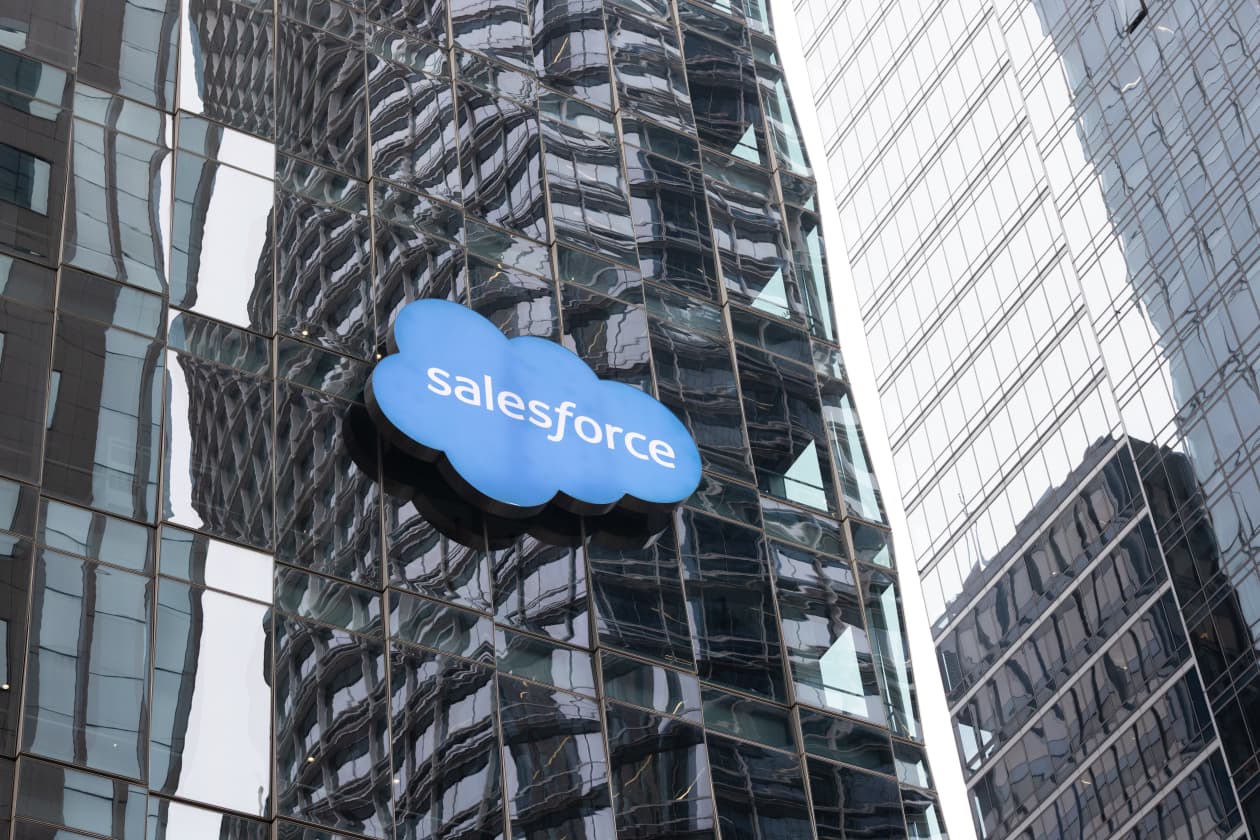
Salesforce plans to conduct accelerated share repurchases worth 14% of the company’s current market value. Photo: Getty Images
Referenced Symbols
Key Points
About This Summary
- Salesforce will issue $25 billion in senior notes to fund accelerated share repurchases, part of a larger $50 billion buyback plan.
- S&P Global Ratings changed Salesforce’s outlook to “negative” from “stable” due to increased leverage from buybacks, potentially doubling in two years.
- CEO Marc Benioff believes Salesforce is “underleveraged,” but analysts question if buybacks are optimal capital use over strategic mergers.
Salesforce’s plan to pour up to $50 billion into stock buybacks was already controversial as analysts assessed whether that money would be better spent elsewhere. And now the software giant has announced it will take on $25 billion in debt to help finance those repurchases.
The company said on Wednesday that it’s priced $25 billion worth of senior notes, with the intention of using “all of the net proceeds” to buy back stock. Salesforce
CRM-0.40% disclosed that it has struck agreements with several financial institutions to conduct accelerated share repurchases amounting to $25 billion following the debt offering.
That $25 billion represents nearly 14% of Salesforce’s $179 billion market capitalization.
See more: Salesforce’s record $50 billion stock-buyback plan is proving controversial on Wall Street
A major debt announcement had been somewhat anticipated on Wall Street, and credit analysts at S&P Global Ratings on Tuesday shifted their Salesforce outlook to “negative” from “stable” due to concerns about increased leverage.
“Although we expect Ebitda will expand and believe Salesforce has strong cash-flow generation to fund some shareholder returns, aggressive buybacks — coupled with acquisitions — could keep leverage elevated longer than expected,” the analysts said ahead of the official pricing, while referring to earnings before interest, taxes, depreciation and amortization.
The analysts further noted the company’s “good growth prospects” but pointed to uncertainty around “its business trajectory over the longer term” since it’s not clear how widely or how quickly artificial-intelligence offerings will be adopted in enterprise settings.
Don’t miss: 7 software stocks to buy as the sector shows signs of life
In a subsequent report on Wednesday, the analysts said that the negative outlook reflects the potential for Salesforce’s leverage to double within the next two years. They assigned an A+ rating to the offering, however, “because the company has some debt capacity at the rating.”
Salesforce CEO Marc Benioff, for his part, said on the last earnings call that he saw the company as “just very underleveraged on our balance sheet.”
The scope of Salesforce’s buyback ambitions invites the age-old debate over whether growth-oriented technology companies should devote so much money to capital returns instead of meaningfully stepping up their business investments.
“While we view the buyback as a positive testament to management’s belief in the [long-term] durability of the business, we question if this is the optimal use of capital given the potential shareholder value that could be unlocked through strategic M&A at current valuations,” D.A. Davidson analyst Gil Luria wrote after the company’s earnings report in February.
He noted that Salesforce returned substantially all of its fiscal fourth-quarter free cash flow back to shareholders. The announcement of the $50 billion program, Luria said, was meant to “capitalize on the current stock-price dislocation.”
Once known for being aggressive with deals meant to spur growth, Salesforce has been following a new playbook when it comes to mergers, according to Benioff’s remarks on the earnings call. Salesforce now has “a much better understanding of how to do acquisitions that are accretive to the business but not dilutive to investors,” he said.
The company will keep doing deals with that framework in mind, he added. But at the same time, Benioff saw an “opportunity to take some of that stock back out of the market” given what he deemed to be “great prices” for buybacks.
Salesforce, like other software companies, has seen its stock come under pressure recently, with investors worried that AI will disrupt traditional software vendors. And zooming out a bit further, Salesforce’s stock has fallen nearly in half since peaking at $367.87 in late 2024.
Companies conduct stock buybacks when they see their shares as undervalued. The repurchases serve to boost earnings per share by reducing the number of shares outstanding.
Watch: Why software stocks are sliding as AI spending explodes
Partner Center
News For You

As Iran conflict and oil roil investors, here’s the next line in the sand for the S&P 500
MarketWatch

Trump Ordered Justice Department Reversal on Law Firm Sanctions
WSJ
Review & Preview: Mission Accomplished?
Barron’s

The stock market is still priced for ‘absolute chaos,’ but the worst-case scenario will be avoided, Nomura strategist predicts
MarketWatch

U.S. Plan to Unblock Strait of Hormuz Collides With Realities of Global Insurance
WSJ

The Stock Market’s Many Concerns Extend Beyond Historic Oil Prices
Barron’s
About the Author

Emily Bary is MarketWatch’s assistant managing editor, tech. She is based in New York.
View this MarketWatch article CLICK HERE
 Media Air Base, LLC
Leave a comment