A Divided $377 Billion Tech Giant Reveals the Perils of AI
February 25, 2026 at 2:00 AM EST

By Chris Bryant
Chris Bryant is a Bloomberg Opinion columnist covering industrial companies in Europe. Previously, he was a reporter for the Financial Times.
In this Article
Mitsubishi Heavy Industries Ltd
Takeaways by Bloomberg AIHide
- Siemens AG and Siemens Energy AG would be Europe’s third-most valuable firm if they were still one company, with a combined market value of €320 billion or so.
- The appeal of Siemens AG and Siemens Energy AG has begun to diverge in the eyes of investors, with the debate being whether they’ll continue to profit from the artificial intelligence boom, or be disrupted by it.
- Siemens Energy AG looks comparatively insulated from the AI threat because it produces gas turbines that power electricity-hungry AI data centers, while Siemens AG’s software activities are seen as more vulnerable to disruption.
Imagine that Siemens AG and Siemens Energy AG were still one company. On paper it would be Europe’s third-most valuable firm with a combined market value of €320 billion ($377 Billion) or so.1 Only Dutch semiconductor equipment maker ASML Holding NV and pharmaceuticals giant Roche Holding AG are worth more.
Yet even as both these former industrial laggards benefit from massive capital spending by technology firms, their appeal in the eyes of investors has begun to diverge. The debate is whether they’ll continue to profit from the artificial intelligence boom, or be disrupted by it. The shift in sentiment underscores the challenges of capital allocation in the AI era, and the pitfalls for investors.
This Pair of German Giants Is Worth More than €300 Billion
Siemens Energy is closing the gap with its former parent
Source: Bloomberg
Note: Siemens still owned 10.1% of Siemens Energy as of mid-November 2025. It held 35% at the time of the spin-off.
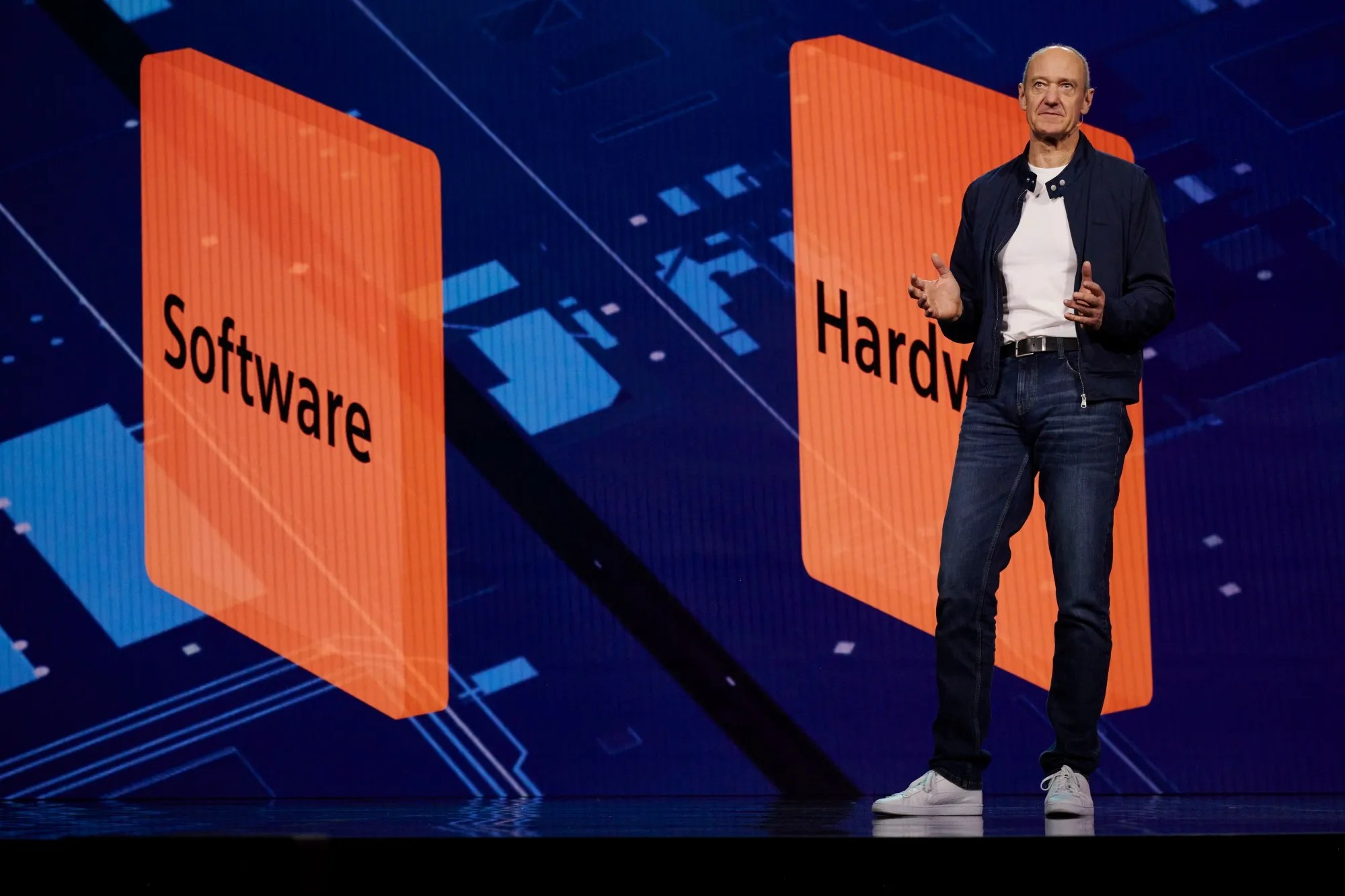
Siemens specializes in factory automation, electrification and building-management systems. It excels in combining machinery with the digital realm and can tap reams of valuable manufacturing data. Clad in a natty bomber jacket, Chief Executive Officer Roland Busch waxed lyrical at the Consumer Electronics Show in January about how the firm would lead the industrial AI revolution. His keynote address included an appearance from Nvidia Corp.’s boss Jensen Huang, who’s equally fond of the corporate rockstar look.BloombergOpinion
- King Charles Should Take a Lesson From His Spanish Cousin
- Race Is the Elephant in the Room of US Foreign Policy
- Net Zero is Dead. Long Live Renewable Energy
- To Trade Coders for Legos, India Needs a Better Deal
But nowadays Siemens produces code, not just capital goods. Industrial software accounts for about 12% of this year’s core sales, according to Morgan Stanley.2 Until recently this was a good thing but suddenly investors are pivoting back toward hardware, seen as a safer port in the AI storm.
Shares in industrial-software peers such as Dassault Systemes SE have slumped because of the perceived threat — whether that’s justified or not remains unclear. Hence, the implied value of Siemens’ software activities is now lower. The stock has declined 13% since hitting a record high in mid-February.
In contrast, its former energy subsidiary looks comparatively insulated because it produces the gas turbines that power electricity-hungry AI data centers. Demand is insatiable, for now.
The gap in market value between the two Siemens businesses has narrowed to about €50 billion from close to €150 billion last spring, even though Siemens AG’s revenues and profits are much higher.
The Spread Between These Two Industrial Giants Has Narrowed
Siemens is now worth only €50 billion or so more than Siemens Energy
Source: Bloomberg
Note: Siemens owned 10.1% of Siemens Energy as of mid-November 2025
“Just when you think you’re winning, you’re not,” Ben Uglow, managing director at Oxcap Analytics tells me. “Siemens is suddenly under a bit of pressure as the market worries maybe this isn’t what we thought, while Siemens Energy is getting uprated on its perpetually improving outlook.”
This change in the pecking order was inconceivable only a couple of years ago. Siemens spun off its energy unit in 2020 after demand for gas turbines waned. In 2023, amid massive losses and quality problems at its wind business, Siemens Energy had to ask the German government for financial guarantees.
By selling Siemens Energy shares directly, handing chunks to its pension fund (which sold them) and electing not to participate in the spin-off’s capital increase in 2023, the parent had reduced its stake to just 10% by the end of its 2025 financial year. It and the pension scheme had held 45% after the split.
Siemens management has called the spin-off a “poster child for crystallizing value.” I agree. Nonetheless, by selling when the share price was depressed, it left tens of billions of euros on the table.3 Siemens Energy’s stock has risen by about 2,300% since the 2023 low. Its orders and cash flow have ballooned because it’s one of the three main global suppliers of gas turbines, along with GE Vernova Inc. and Mitsubishi Heavy Industries Ltd.
Siemens isn’t the first industrial company to have underestimated a future star. Royal Philips NV’s separation from ASML ended up being far more costly — the lithography-equipment maker’s market value is now 19 times higher than Phillips’, which sold its last ASML shares in 2004.
Of course, it’s hard to imagine the Siemens gas-turbine and grids business being valued as highly as part of a conglomerate. Siemens’ decade-long effort to streamline its unwieldly structure was definitely worth it. A company once renowned for unpleasant earnings surprises is much more profitable, focused and reliable. Its shares are also valued at a much higher multiple of earnings than before, albeit still at a discount to industrial peers such as Schneider Electric SE, which has a greater share of sales tied to data centers.
Siemens has sold a hodgepodge of other non-core activities and is preparing to cut its two-thirds shareholding in listed healthcare-tech business Siemens Healthineers AG, by spinning-off a 30% stake to its own shareholders.
The parent group’s management has compared its portfolio moves to private equity, and just like PE it has ploughed a lot of cash into software acquisitions. The hope was investors would applaud industrial companies for investing in higher-margin software with recurring revenues. Now, there are questions about the prices paid.
Industrial Software Stocks Have Been Hit By AI Fears
But it remains far from clear these companies will be displaced
Source: Bloomberg
Note: Data is normalized with percentage appreciation as of August 25, 2025.
Last year Siemens spent some $15 billion acquiring Altair Engineering Inc. and Dotmatics, which make industrial simulation and life-sciences R&D software respectively. Both deals were priced at a punchy 15-16 times revenue.
Overall Siemens has invested about €28 billion building its software portfolio since 2007. This has made it a leader in deeply specialized technology such as software for managing the lifecycle of industrial goods and creating digital replicas of products, factories and manufacturing processes. Its tools are used by semiconductor firms like Nvidia to design chips.
I doubt this stuff is really vulnerable to AI disruption. Advanced factories can’t afford AI hallucinations, or to ignore the laws of physics. Siemens expects its software tools to be enhanced by AI agents, not made redundant by them. Engineering-software companies are more insulated because of “deep workflow integration, entrenched user bases and high liability risks,” Bloomberg Intelligence senior analyst Niraj Patel writes.
Still, we’ve probably not been through the last AI panic for manufacturing specialist. Who knows what Anthropic PBC and its ilk will accomplish next?
Siemens Energy, meanwhile, is in a less exposed position. Its record €146 billion order backlog — almost half of it for maintenance work — will keep it busy for years.
It says only 25% of gas-turbine demand is tied to data centers, meaning there are other sources of growth if the tech giants stop spending. Although the stock is hardly cheap at 42 times forward earnings, that’s less stretched than US rival GE Vernova’s almost 60 times.
Gas Turbine Orders Are The Highest in a Quarter Century
Electricity-hungry data centers have underpinned a resurgence of gas
Source: McCoy, Morgan Stanley
Siemens Energy is facing calls to consider some portfolio trimming of its own. Its troublesome wind-turbine activities should be separated, argues activist Ananym Capital.
The company’s management prefers to wait, which is understandable given the ups and downs of the energy business. The wind unit is poised to break even again and although US President Donald Trump despises renewables, the world will at some point have to stop burning as many hydrocarbons.
As Europe’s political leaders debate what industries to champion in a world where they can no longer rely on their old US ally, the Siemens example shows how impossible such choices can be. Yesterday’s cast-offs can become tomorrow’s winners. And vice versa.
More from Bloomberg Opinion:
- AI Panic Ignores Something Important. The Evidence: Parmy Olson
- Who’s On the Other Side of the Big AI Selloff?: Chris Hughes
- Wall Street’s Doom-Mongering on Software Is Bizarre: Dave Lee
Want more Bloomberg Opinion? Terminal readers head to OPIN <GO> . Or subscribe to our daily newsletter.
- Siemens owned 10.1% of Siemens Energy as of mid-November, so I’ve subtracted 10% of the latter’s market cap from the combined total to prevent double-counting.View in article
- In other words, excluding Siemens HealthineersView in article
- Siemens received €3 billion of cash proceeds from selling shares in Siemens Energy. It contributed more than €3 billion of shares to the Siemens Pension-Trust, which sold them. A 10% stake is worth around €14 billion..View in article
This column reflects the personal views of the author and does not necessarily reflect the opinion of the editorial board or Bloomberg LP and its owners.

Chris Bryant is a Bloomberg Opinion columnist covering industrial companies in Europe. Previously, he was a reporter for the Financial Times.
View this Bloomberg article CLICK HERE
 Media Air Base, LLC
Leave a comment