UK Calls Time on Brexit Years and Vows Closer Ties With EU
Add us on Google
Provide news feedback or report an error
By Alex Wickham and Ellen Milligan
February 14, 2026 at 6:09 AM EST Updated on
Takeaways by Bloomberg AIHide
- Prime Minister Keir Starmer said Britain is no longer the country that voted for Brexit and vowed to build a closer relationship with the European Union.
- Starmer will pursue tighter UK-EU relations on defense and trade “with some urgency” and said the prize is “greater security and stronger growth”.
- He called for a radical overhaul of transatlantic relations to end years of “over-reliance” on Washington and move toward a relationship based on “interdependence”.
Prime Minister Keir Starmer said Britain is no longer the country that voted for Brexit and vowed to build a closer relationship with the European Union.
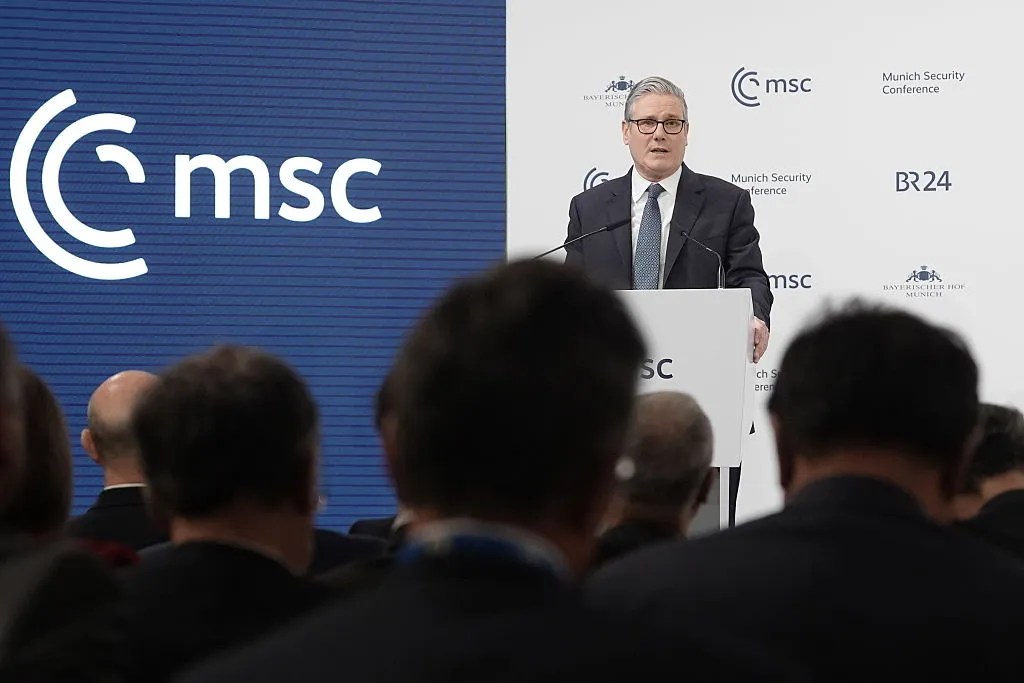
Appearing on stage Saturday alongside European Commission President Ursula von der Leyen at the Munich Security Conference, Starmer said he’ll pursue tighter UK-EU relations on defense and trade “with some urgency.”
“We are not the Britain of the Brexit years any more,” he said to loud applause from an audience of mainly diplomats and officials.
The embattled prime minister conceded that strengthening relations with the EU will mean political trade-offs at home, but insisted that it is the right thing to do for the national interest.
“The prize here is greater security and stronger growth,” he said.
The speech was Starmer’s most detailed analysis of British foreign policy and European security to date, coming at a time when he is under intense domestic pressure over his political position. It was also his strongest language yet on taking the UK closer to the EU.
UK Defence Secretary John Healey said it would have been hard to imagine “a British prime minister sharing a stage with the president of the European Commission” just two years ago, taking a swipe at former premier Rishi Sunak who delivered his speech in Munich in 2023 to a half-empty room.
“It’s a sign here today that people are looking to the UK and to Keir,” Healey told Bloomberg. “It’s a sea-change and hallmark of this conference compared to two years ago.”
UK PM Keir Starmer speaks alongside EU Commission President Ursula von der Leyen at the Munich Security Conference, 14 Feb 2026.
Starmer outlined a more nuanced and pragmatic position for the UK in comparison to Canada’s Mark Carney and French President Emmanuel Macron, who’ve warned of an historic decoupling from the US.
Instead, Starmer wants Britain to bolster ties with Europe while maintaining close relations with Washington, a stance more similar in tone to that German Chancellor Friedrich Merz, in part because of Britain’s unique interconnectedness with America on nuclear deterrence and intelligence. He rejected talk of a “rupture.”
“That could prove to be a moment of destruction,” he said. The US, he added, “remains an indispensable ally.”
Nonetheless, he called for a radical overhaul of transatlantic relations to end years of “over-reliance” on Washington and move toward a relationship based on what he called “interdependence.”
“Rather than pretending we can replace all US capabilities, we should decrease some dependencies and diversify,” he said. “We recognize things are changing.”
He called for closer UK-EU cooperation on defense financing and said he would look for innovative proposals for how to fund increases in expenditure. Healey said that those options include looking at joint financing, joint programs and industrial procurement — confirming Bloomberg’s reporting that the UK is considering proposals to keep joint borrowing for stockpiling and procurement off its books.
Starmer also said that the UK is enhancing its nuclear cooperation with France. Macron vowed to take a more “holistic approach” to his country’s nuclear deterrence, which unlike Britain, doesn’t currently extend to NATO. European capitals are discussing how to develop their own nuclear capabilities, with Macron expected to offer France’s capability to the rest of Europe later this month.
Europe Talks Nuclear Weapons After US Delivers Reality Check
Hours after Starmer’s speech, the UK announced that tests on samples from Russian opposition leader Alexey Navalny’s body show he was poisoned with a rare toxin found in the skin of Ecuador dart frogs two years ago. Britain said it held Russia responsible for his death. Foreign Secretary Yvette Cooper met with his widow, Yulia Navalnaya, in Munich to share the results of the laboratory work.
It’s the latest example where the UK is working to expose Russian aggression. Starmer in his speech said that Russia’s threat to Europe will increase, even if there is a peace deal on Ukraine, because Moscow would use it as an opportunity to rearm.
He also touched on the deeper problem facing leaders across Europe: how to prepare voters for the costs and sacrifices of an era of global tensions when budgets are already under stress and they’ve grown accustomed to decades of relative peace.
He warned that in the 1930s, European leaders were too slow to level with the public about the realities and that now they “must build consent about decisions we must take to make us safe.”
“The road ahead is straight and clear. We must build our hard power because that is the currency of the age,” he said, in comments that will spur expectations that he will have to more rapidly increase UK defense spending.
He said the UK will deploy its Carrier Strike Group to the Arctic this year alongside US and Canadian forces and stressed that the UK would defend any NATO country that comes under attack under its Article 5 clause.
“Be in no doubt,” he said, “if called upon, the UK would come to your aid today.”
View this Bloomberg article CLICK HERE
 Media Air Base, LLC
Leave a comment