Analysts predict that US stocks will remain high in 2026… Pay attention to the movement of the four factors that support stock prices
#US stocks #Wall Street #Stock market #Investment
Naomi Buchanan [Original] (Translation: Fumiko Nakata, Editing: Toshihiko Inoue)

- While valuations in U.S. stocks are at a premium level, analysts at Piper Sandler don’t expect this situation to change in 2026.
- According to the company, high profit margins, tight credit spreads, low oil prices, and low inflation are supporting current valuations.
- If any of these four trends “sustainably reverse,” it will be a risk for U.S. stocks.
Analysts at investment bank Piper Sandler pointed out four key factors supporting valuations as the S&P 500 index continues to be at its highest, noting that “a sustained reversal of any of these trends poses a potential risk to the market.”
There are concerns on Wall Street that the U.S. stock market is overpriced, but analysts at the bank do not see valuations moving significantly in either direction through 2026, and “our view is that the stock price multiplier will remain high for a long time.”
However, Piper Sandler says there are four factors supporting high valuations, and if any one of them collapses, it could cause a sharp decline in valuations.
Valuations should not be used to measure the timing of buying and selling in the market, but rather should be seen as an indicator of “how investors perceive risk,” according to analysts. Charles Schwab also emphasizes this point, saying that “valuations are the worst way to measure market timing,” but that high valuations can be a clue to whether the market is vulnerable to shocks.
Here are four factors that Piper Sandler believes are supporting high valuations:
High profit margins
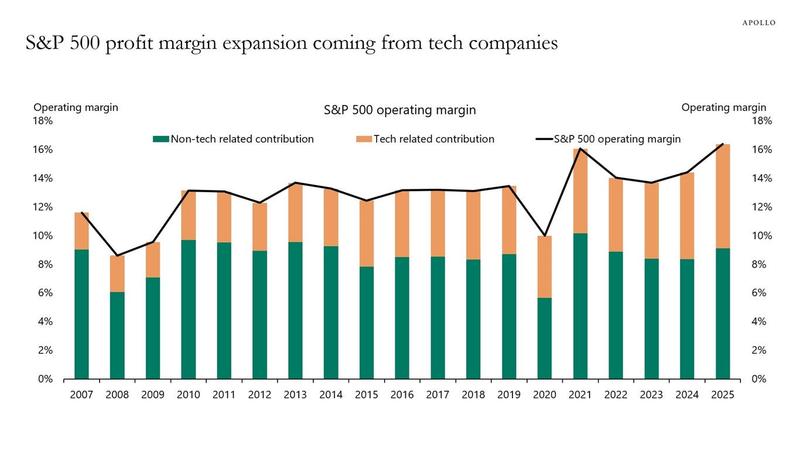
According to Piper Sandler, the current high stock valuation reflects the company’s high operating margin. The growth in operating margin, which indicates the percentage of sales after deducting operating expenses, suggests that the efficiency of the company is improving.
These high profit margins are primarily driven by technology-related sectors. Torsten Sløk, chief economist at Apollo Global Management, pointed out that “all of the S&P 500 operating margin increases over the past 20 years have been due to technology-related sectors.”

Purpose alone does not move an organization. Why do we need a “story”?
The enthusiasm for AI is expected to not only boost the market but also lead to increased productivity and operational efficiency, supporting high profit margins. “Technology is a steroid to increase profit margins,” said Sébastien Page, global head of multi-asset and chief investment officer at T. Rowe Price, noting that the U.S. stock market has historically continued to outperform compared to other markets around the world.
Tight credit spreads
Credit spreads are “at historic lows,” Piper Sandler said, explaining that this tight spread is supporting stock valuations.
Tight credit spreads mean that companies have lower borrowing costs. This means that the “difference” between the interest rate charged by lenders to companies and benchmark interest rates such as U.S. Treasury yields is small.
Brent Olson and Tom Ross, portfolio managers at Janus Henderson Investors, point to the mid-2000s and late 2010s, when spreads were at historically low levels. He said spreads could remain tight in the future. The reasons for this include a robust global economy, additional interest rate cuts by the Federal Reserve, less corporate bonds issued than government bonds, and corporate rating updates.
In their view, the “biggest threat” to credit spreads is “shocking economic data” that suggests a recession or the Fed raising interest rates in response to a surge in inflation.
Crude oil safety
Oil prices fell in 2025 and have picked up since the beginning of the year, but upside is still held back on the back of the prospect of increasing supply and uncertainty about demand.
From healthcare to manufacturing. Dassault Systèmes innovations redefine the world
Sponsored Content by Dassault Systèmes
Advertisement
Piper Sandler compared the price-to-earnings (P/E) ratio of oil prices to the S&P 500 stock index and showed that the relatively low level of oil prices supports the valuation of the S&P 500.
“In recent years, falling energy prices have played an important role in boosting stock market stock price ratios,” the analyst said. It also points out that low energy costs are a factor that makes real interest rates feel lower than the level suggested by U.S. Treasury yields.
Low inflation
Piper Sandler noted that the “subside” of inflation is supporting the U.S. stock market, comparing the market’s performance with data from the core personal consumption expenditures (PCE) price index, which is a measure of inflation that the Fed values.
“In the post-corona world, investors have a stronger sensitivity and fear of inflation,” he said, adding that low inflation will be a “tailwind” for stock price multiples.
A survey by LPL Research also shows a trend that “equity valuations are highest when inflation is at its lowest, as indicated by the Consumer Price Index (CPI), and vice versa.”
View this Money Insider by Business Insider CLICK HERE
 Media Air Base, LLC
Leave a comment