Wall Street’s wild week rattles investors’ confidence while highlighting a growing divide within markets
‘It seems like there are two different markets right now,’ strategist says
By Isabel Wang, Gordon Gottsegen and Joseph Adinolfi
Published: Feb. 7, 2026 at 9:00 a.m. ET
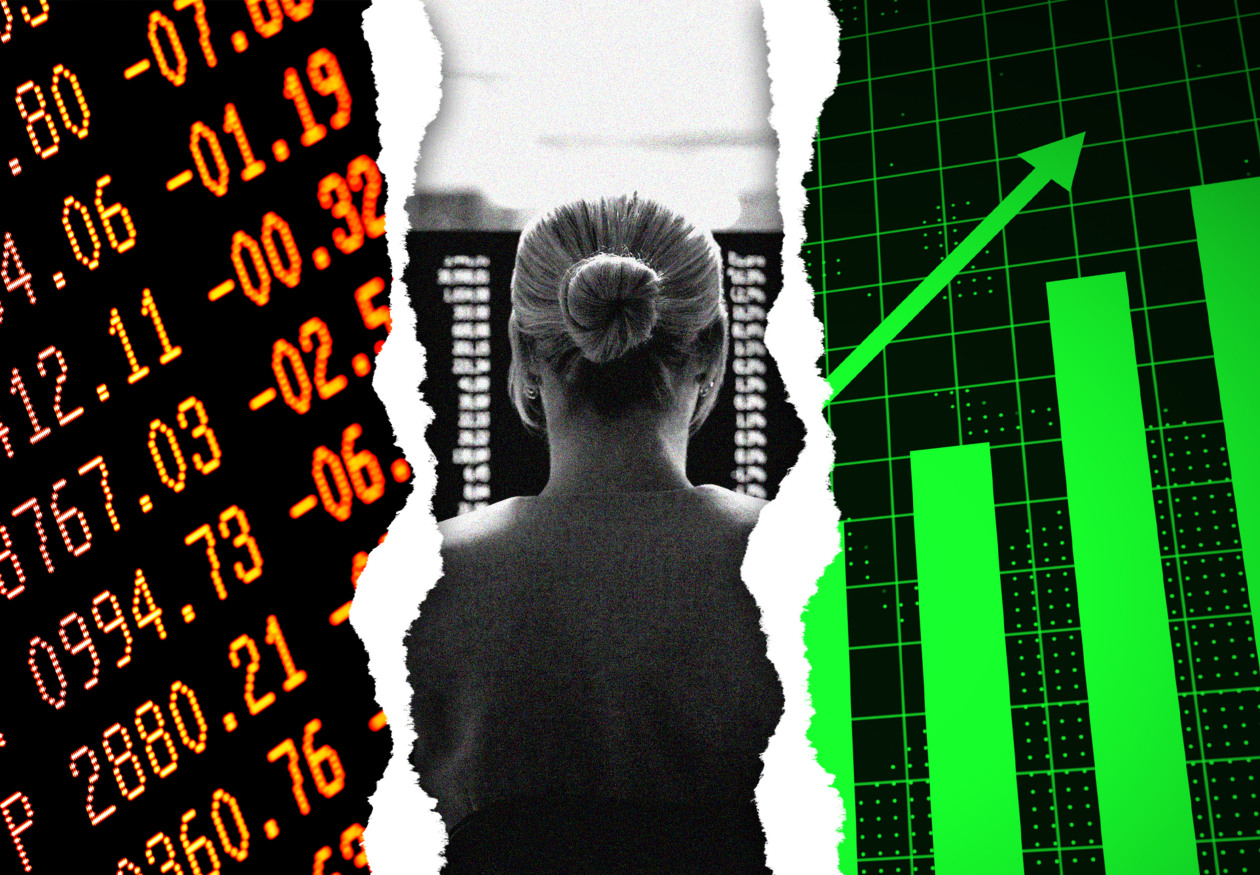
Markets are looking increasingly divided between retail favorites and steady performers.Photo: MarketWatch photo illustration/iStockphoto
Referenced Symbols
- DJIA+2.47%
- RSP+1.86%
- SPY+1.92%
- SI00+4.38%
- BTCUSD-2.30%
- IGV+3.50%
- SP500.30+1.31%
- SP500.20+2.84%
- SP500.15+1.77%
- SPX+1.97%
- COMP+2.18%
- AMD+8.28%
- GOOGL-2.53%
- GOOG-2.48%
Key Points
About This Summary
- Momentum trades, including silver and bitcoin, experienced significant declines, with silver falling over 35% and bitcoin losing more than half its value.
- Value-oriented investments and cyclical sectors outperformed, with the Dow Jones Industrial Average topping 50,000 and consumer staples rising 6%.
- Concerns about AI’s impact on business models and weaker-than-expected guidance from Advanced Micro Devices Inc. contributed to market shifts.
Wall Street lived a tale of two markets this week.
Once-popular momentum trades that showered investors with outsize rewards last year finally hit the skids. Wednesday was the worst single-day showing for popular momentum stocks since 2022, based on the performance of Goldman Sachs’s U.S. High-Beta Momentum Index — although the index rallied back to finish the week essentially unchanged.2023’25-0.15-0.10-0.0500.050.10
Meanwhile, boring yet steady value plays quietly stacked wins, with the value-heavy Dow Jones Industrial Average
topping 50,000 pointsw for the first time ever. A fund that tracks the equal-weighted version of the S&P 500 index
finished the week at a fresh record high, outperforming its capitalization-weighted sibling
by the widest weekly margin since 2020, FactSet data showed.
Why investors seeking diversification should look to emerging markets.
“It seems like there are two different markets right now,” said Mark Hackett, chief market strategist at Nationwide, during an interview with MarketWatch. “There are the ones that are levered and volatile, and the ones that are just set-it-and-forget-it.”
Silver
and bitcoin
were two examples of the type of levered, retail-driven markets Hackett was referring to. Over the past few months, individual investors have become much more involved in the silver trade, he noted.
Based on trading in the most active futures contract, silver has fallen by more than 35% from its intraday record north of $120 an ounce, Dow Jones Market Data showed. Bitcoin briefly erased more than half of its value earlier this week, before a Friday rebound pushed it back up to the $70,000 threshold — though it’s still well below its record high north of $126,000 from October.
Software stocks, which minted gains for investors for years, also got hammered this week. The iShares Expanded Tech-Software Sector ETF
fell 8.7% this week, its worst showing since April 4, FactSet data showed.
“Active traders can and do migrate between hot stocks and sectors, and when those sectors fall out of favor, they decline,” said Steve Sosnick, chief market strategist at Interactive Brokers. In many cases, momentum trades are being kept afloat by the speculations rather than valuations, he added.
At the other end of the spectrum, previously lagging cyclical and defensive names outperformed the broader market this week, helping buck the downtrend for the major indexes. The S&P 500’s consumer-staples sector
was the best performer among the large-cap index’s 11 sectors, up 6% for the week. The industrials
and materials
sectors were also up 4.7% and 3.5% for the week, respectively, according to FactSet data.
The broad-based gains resulted in more stocks within the S&P 500 moving higher, even as weak performance by the index’s dominant tech names pushed it lower. On Wednesday, 92 S&P 500 members tallied fresh 52-week closing highs, the most since November 2024, Dow Jones Market Data showed.
The split underscores the sentiment tug-of-war on Wall Street — with risk-takers chasing hype, while steady hands take a more measured approach. A crucial takeaway of the week might be that as investor sentiment and leveraged bets continue to drive swings in broad swaths of the market, more wild moves could be in store.
See: Dow closes above 50,000 for first time after rough week for U.S. stock market
Wild swings in individual stocks and assets still managed to bleed into the major U.S. equity indexes, with all three snapping back and forth like a yo-yo. The Dow Jones Industrial Average managed a weekly gain of 2.5% as stocks staged a strong recovery on Friday.
The rebound gave the S&P 500
and the Nasdaq Composite
their best days since at least Nov. 24, yet both tech-heavy indexes ended the week down 0.1% and 1.8%, respectively, according to FactSet data.
To be sure, there was no obvious villain, like a geopolitical shock or tariff threats, sending the market into a tailspin this week. Instead, it was just a steady stream of corporate and economic headlines chipping away at risk appetite, forcing both speculators and value investors to second-guess everything they thought they knew.
It started with a new automation tool from Anthropic, the developer behind the Claude chatbot, which on Tuesday sparked a selloff across software and financial-services stocks due to concerns that AI could erode their business models. The anxiety then spilled into the broader market on Thursday after Advanced Micro Devices
issued weaker-than-expected guidance for the first quarter and Google parent Alphabet
doubled its planned AI spending for 2026. Together, these developments reignited fears over whether AI will truly live up to the hype.
Other macro concerns, such as a weakening labor market and upcoming nuclear talks between the U.S. and Iran, also weighed on market sentiment.
“People are actually going back to something everyone’s forgot about for a long time — you’re actually seeing some value [investing] or fundamentals coming back in,” said Ben Fulton, CEO of WEBs Investments.
In Fulton’s views, momentum stocks did “run far ahead of fundamentally sound companies,” so investors need to “realign the car” while markets are moving quickly.
Partner Center

Hims & Hers stock poised for heavy losses after quick U-turn on plan for oral Wegovy competitor

U.S. stock futures rise after a wild week on Wall Street, ahead of key jobs and inflation reports

After bitcoin’s fall, pity those wildly enthusiastic investors who borrowed billions against crypto

I settled my father’s estate, but found a will deeding a mobile home to his stepson. Am I ethically and legally obliged to fix this?

‘I’m not made of money’: My heating engineer didn’t fix my radiators on his first visit. Do I pay him a second time?
About the Author
Isabel Wang is a Markets Reporter for MarketWatch
 Media Air Base, LLC
Leave a comment