How a $30 Billion Welfare Program Became a ‘Slush Fund’ for States
Republicans and Democrats alike decry the lack of oversight for America’s famous antipoverty experiment. ‘Fraud by design.’
By Cameron McWhirter, Dan Frosch and Scott Calvert
Feb. 7, 2026 9:00 pm ET
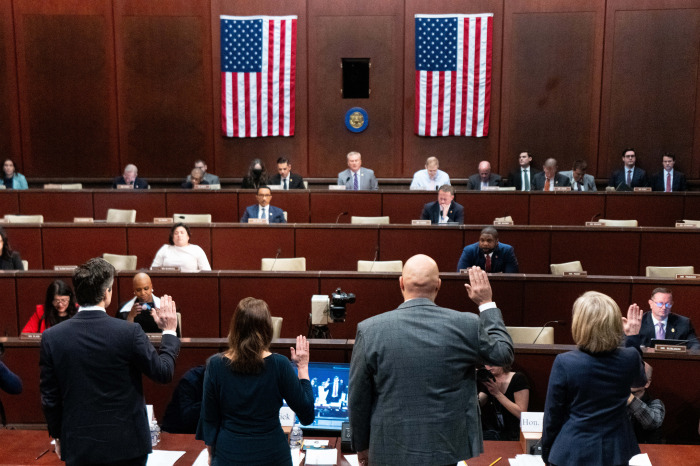
Witnesses are sworn in at a hearing concerning TANF. Bill Clark/Zuma Press
Quick Summary
- The Temporary Assistance for Needy Families (TANF) program, providing more than $30 billion, has faced longstanding issues with financial oversight and questionable spending across states.View more
When the Trump administration targeted billions of dollars in federal welfare funds recently over fraud concerns, it singled out five Democratic-run states.
An examination by The Wall Street Journal found that the main federal aid program the administration is seeking to block, Temporary Assistance for Needy Families, or TANF, has long been plagued by poor financial oversight and questionable spending in states led by both Republicans and Democrats.
Auditors in numerous states, including Connecticut, Louisiana and Florida, have uncovered problems with TANF—once America’s primary welfare program for low-income families. Created three decades ago, it comprises more than $30 billion.
TANF funds flow annually through block grants to states, which have wide latitude to spend them and minimal reporting requirements—a structure critics say hampers oversight. Meant to allow states to be creative in serving needy families, it has resulted in a shift: States now award most of the money to nonprofits, companies and their own state agencies. An average of about 849,000 families got direct cash aid each month in fiscal 2025, federal data shows, down from about 1.9 million in fiscal 2010.
Audits have shown a range of problems, including states inaccurately reporting large expenditures and disbursing millions of dollars to contractors without tracking how the cash was spent. State and federal records show red and blue states alike have directed hundreds of millions of dollars to programs with tenuous—or no—connections to TANF’s goals.
Questionable expenditures have included college scholarships that benefited middle- or upper-income families, antiabortion centers, a volleyball stadium in Mississippi, and an Ohio job-training nonprofit where leaders and employees were later sentenced to prison after prosecutors said they used TANF money for vacations, real estate and salaries for people who didn’t work there.
Both conservative and liberal groups—and repeated reports from the Government Accountability Office, Congress’s nonpartisan watchdog—say the federal government for years hasn’t paid enough attention to how states use the money.
What’s News
Catch up on the headlines, understand the news and make better decisions, free in your inbox daily. Enjoy a free article in every edition.PreviewSubscribe
Last year, the GAO identified 37 states where recent audits found 162 deficiencies in financial oversight, “56 of which were severe.” It criticized “opaque accounting practices” by many groups receiving TANF funds.
States often use TANF money as a “slush fund” to plug budget shortfalls and finance initiatives that don’t help poor people get jobs or strengthen families, said Hayden Dublois of the conservative Foundation for Government Accountability. He describes TANF’s lack of oversight as “fraud by design.”
“There are very little, if any, safeguards,” said Dublois, who estimates one in five TANF dollars, or about $6 billion, is misspent every year.
Ann Flagg, the top TANF official under then-President Joe Biden, said she and other officials tried to rein in questionable state spending through a proposed regulation change that would have limited how TANF dollars can be spent.
“Knowing that there were so many layers between the activity on the ground and the federal perch, there were many, many instances, I am sure, that funds were used in crazy ways,” she said.
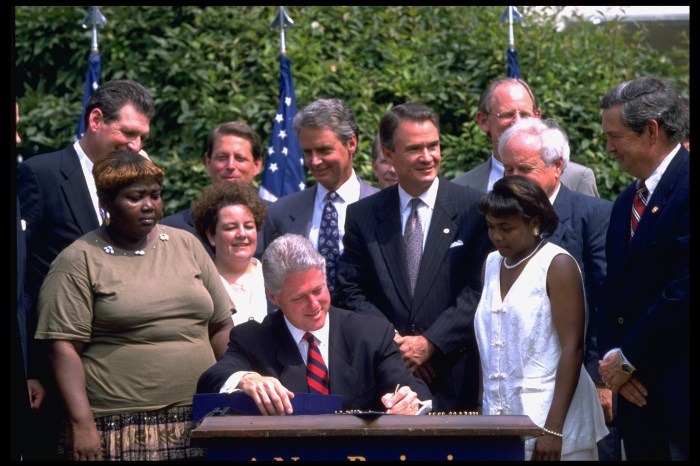
President Bill Clinton, signing a welfare-reform bill in 1996, spoke of ‘ending welfare as we know it.’ Dirck Halstead/Getty Images
Trump has focused on fraud after a safety-net scandal in Minnesota, but those cases don’t involve TANF. The most prominent scandal involving TANF funds, at least $77 million, took place several years ago in Mississippi. The Trump administration in January signaled plans to extract a potentially hefty penalty from the state after earlier pausing a Biden administration effort to do so.
Reinventing welfare
Today’s TANF program was created during a fleeting moment of bipartisan cooperation 30 years ago. The GOP, led by House Speaker Newt Gingrich, pushed for the welfare overhaul as part of the Republican “Contract with America.” Leaders of both parties hailed the program as giving more freedom to states, which knew their own needs better than anyone in Washington.
President Bill Clinton praised it for “ending welfare as we know it.”
States which receive TANF funds were given broad flexibility to disburse the money as they saw fit. Some observers point to successes, primarily a dramatic drop in welfare rolls, though critics say that was driven partly by onerous work requirements and not declining poverty rates.
TANF, overseen by the U.S. Department of Health and Human Services, supplies $16.5 billion a year from the federal government, matched by about $15 billion in state funds. Nationwide, around 20% of impoverished families receive cash assistance, according to recent analyses. Time-limited maximum monthly payments for a family of three ranged from $204 in Arkansas to $1,370 in Minnesota in 2024.
“The program has drifted away from the core purpose of supporting families with very little income,” said Nick Gwyn, who studies TANF for the Center on Budget and Policy Priorities, a left-leaning think tank.
Audits and reports on the use of TANF funds have been limited in scope. But those conducted show state officials have often failed to track where the money goes or whether it is spent properly.
A Louisiana audit in 2024 found that state employees didn’t verify or document the hours worked by some TANF enrollees, a federal requirement. It was the 13th consecutive year that auditors had reported the same problem. The audit also said the state hadn’t accurately documented TANF distributions to contractors.
Louisiana said it concurred with the findings and would step up compliance.
In Connecticut, auditors said the state in 2024 didn’t sufficiently review the financial reports of 131 subcontractors who received $53.6 million in TANF funds, making it difficult to assess whether the money was being spent on “allowable activities.”
Connecticut promised to verify that contractors met their obligations.
Oklahoma Republican state auditor Cindy Byrd said her agency’s audits have found weak or nonexistent documentation showing how TANF funds have been spent.
The GAO recommended at least as early as 2012 that Congress tighten reporting requirements for TANF spending by states, and called on HHS to increase program auditing. No legislation was passed.
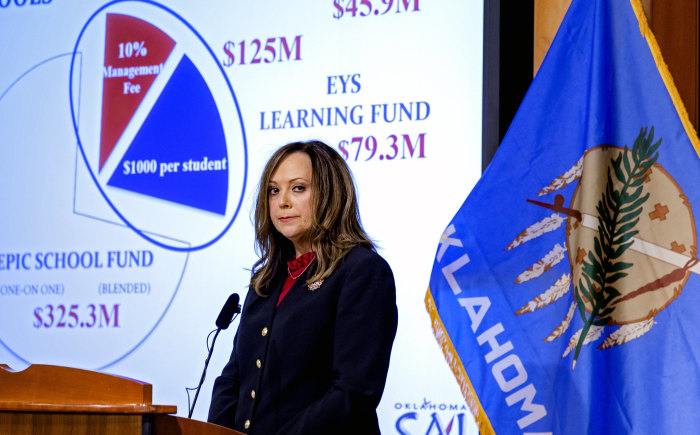
Oklahoma state auditor Cindy Byrd pointed to instances of weak or nonexistent TANF documentation. CHRIS LANDSBERGER/Associated Press
In 2016, an HHS official testified before a House committee that limitations in federal law prevented the agency from estimating improper payments in TANF. “That doesn’t make any sense to me,” Republican Rep. Gary Palmer of Alabama said at the time.
In a recent interview, Palmer said he supports mandating such reporting through legislation. “Just from fiscal responsibility, we have an obligation to do this,” he said. Several Democrats have pushed for legislation to monitor third-party TANF contractors.
Unlike with some other welfare programs, states don’t have to spend all their TANF money in a single year, and many have built up large surpluses. In times of fiscal pressure, such as the 2007-09 recession, many states used TANF funds for purposes that had little to do with the program’s original goals, said Robert Rector, a senior research fellow at the conservative Heritage Foundation who helped draft the 1996 legislation that created the program.
He said as the number of welfare recipients dropped, states were supposed to direct funds to help poor parents get jobs and to strengthen families. Instead, states spent the money on unrelated programs, and the federal government didn’t intervene.
“Today all states are in de facto violation of the law” because they aren’t spending all TANF funds on the 1996 law’s goals, Rector said in an interview.
Rector said Democrats and Republicans are both to blame after the law was passed. Many Democrats didn’t want the reforms, and Republicans, after 1996, “told their base that they had ended welfare and just closed the book. I was flabbergasted,” he said.
Scholarships for rich kids
Missouri set aside several million dollars in TANF funds annually in recent years for its Alternatives to Abortion program, state records show. For this fiscal year, the state says it allocated about $12 million in TANF funds to 10 providers, including eight antiabortion pregnancy resource centers.
The program aligns with TANF’s aim of supporting needy families so children can be cared for at home, a Missouri state Department of Social Services spokeswoman said. During pregnancy and for a year after a child’s birth, low-income parents can access services such as counseling and parental education and get help with basic needs.
Abortion-rights supporters say using TANF for services limited to poor Missourians who commit to taking a pregnancy to term is a misuse of funds and intended to support a conservative agenda.
Some states spend large amounts of TANF dollars on child-welfare programs such as foster care, despite receiving dedicated funding for them from other sources, Kathy Larin, a GAO director, testified to Congress in April 2025. “States told us they use TANF because it’s more flexible and can cover costs not eligible” for reimbursement, she said.
Texas used about $251 million of its $884 million in TANF expenditures in fiscal year 2023 on child welfare and foster-care services and payments, according to federal data. The state used just 1.9% of its TANF dollars on basic assistance to needy families. Texas officials didn’t respond to requests for comment.
States use TANF for so many purposes that it raises the question of who is benefiting, the GAO’s Larin said. For example, she noted, one state has a “marriage promotion program, but they can’t assess whether the program improved marriage quality or duration.”
Several states have also used TANF money for programs available to people well above the poverty threshold.
Between 2011 and 2024, Michigan faced criticism for pumping more than $750 million in TANF funds into two college scholarship programs that aided many students from middle-income and even affluent families, according to the nonprofit Michigan League for Public Policy.
In November 2024, under Biden, the federal Administration for Children and Families, which oversees TANF, picked five states—California, Minnesota, Kentucky, Maine and Ohio—for a pilot program aimed at measuring outcomes of TANF spending to improve effectiveness.
SHARE YOUR THOUGHTS
What steps should Congress take to reform the TANF program? Join the conversation below.
Months later, the Trump administration canceled the pilots except in Ohio, and substituted in Arizona, Virginia, Iowa and Nebraska.
In April 2025, the GAO again called for Congress to require states to provide more data on TANF spending.
So far, Congress hasn’t acted on the proposal, and the Trump administration has taken no position on the issue.
The GOP’s “One Big, Beautiful Bill,” a tax-and-spending megabill passed in 2025, imposed various requirements on states’ spending of federal social-welfare funds, including stricter verifications for SNAP and Medicaid recipients. States can be penalized if error rates are too high. But the legislation didn’t address TANF.
Last month, the administration said it was freezing about $10.6 billion in child-care and family-assistance grants, much of it under TANF, to the Democratic-led states of California, Colorado, Illinois, Minnesota and New York.
The states sued, and a federal judge temporarily blocked the administration’s effort. The federal agency that administers TANF declined to comment, citing the pending litigation.
Copyright ©2026 Dow Jones & Company, Inc. All Rights Reserved.
Appeared in the February 9, 2026, print edition as ‘How Federal Welfare Program Became ‘Slush Fund’ for States’.
Cameron McWhirter covers national affairs for The Wall Street Journal from Atlanta. Before joining the Journal, he reported for the Atlanta Journal-Constitution from 2003 to 2010. Previously, he worked as a reporter for the Detroit News and other newspapers.
Cameron holds a bachelor of arts in history from Hamilton College and a master’s from Columbia University’s Graduate School of Journalism. He has been a Thomas J. Watson Fellow in Eritrea and Sudan, a Nieman Fellow at Harvard University and a writing fellow at the MacDowell artist residency. He is the co-author of “American Gun: The True Story of the AR-15,” published in 2023. His first book, “Red Summer: The Summer of 1919 and the Awakening of Black America,” was published in 2011.Follow
Dan Frosch writes about the U.S. economy for The Wall Street Journal, with a focus on poverty and inequality.
Since joining the Journal from the New York Times in 2014, Dan has covered a broad range of topics and regions—from gun violence to Native American health care to the Rocky Mountain West.
He was part of a Journal team that was a 2021 Pulitzer finalist for its coverage of the Covid-19 pandemic. He helped lead a Wall Street Journal-PBS Frontline series on sexual abuse at Indian Health Service hospitals that won the 2019 Worth Bingham Prize for Investigative Journalism and received an Emmy News and Documentary nomination. Stories that he and several Journal colleagues authored on violent crime during the pandemic earned awards from the New York Press Club and the National Association of Black Journalists in 2023.
Dan is a 1999 graduate of Beloit College.
Scott Calvert is a Baltimore-based national affairs reporter for The Wall Street Journal. He previously covered general news in the mid-Atlantic region, as well as K-12 education issues nationally. He has also written extensively about transportation, with a focus on highway safety.
Before joining the Journal in 2014, he spent 14 years at the Baltimore Sun, where his assignments
Visit this Wall Street Journal article CLICK HERE
 Media Air Base, LLC
Leave a comment