RBA Hike Spotlights Inflation Pressure Central Banks Can’t Fix
In this Article
Commonwealth Bank of Australia
Provide news feedback or report an error
By Swati Pandey
February 6, 2026 at 4:26 AM EST
Takeaways by Bloomberg AIHide
- Australia’s central bank chief Michele Bullock explained that one of the main inflation drivers is beyond her control, citing the economy being “capacity constrained” due to supply and labor bottlenecks.
- The RBA’s rate hike highlighted the challenge of inflation drivers being beyond the reach of monetary policy, as governments push budgets to finance support for aging populations and energy transitions.
- Australia’s experience highlights a challenge in the post-Covid inflation era, where price pressures are driven by demand overheating, structural constraints, and fiscal momentum, exacerbated by anemic productivity growth.
Australia’s central bank chief Michele Bullock strode into a committee room in Parliament House on Friday morning primed to explain what’s causing the inflation that forced this week’s interest-rate hike — the world’s first of 2026.
As opposition lawmakers scented an opportunity to land a political blow on the dominant government of Prime Minister Anthony Albanese, she spent much of the morning parrying political questions on the role played by its spending choices.
What she tried to make clear, however, is that one of Australia’s main inflation drivers is beyond her control at the central bank, even if it’s technically the RBA’s job to tame prices. There are also deeper causes than just Albanese’s fiscal choices.
The point, she said, is “the extent to which the economy is capacity constrained.”
That is, an economy like Australia’s facing supply and labor bottlenecks can only grow so fast without fueling inflation.

The RBA’s rate hike this week highlighted this challenge, which many developed economies now face. As governments push budgets deep into the red to finance support for aging populations, military upgrades and energy transitions, Australia offers a cautionary tale of how inflation drivers can often be beyond the reach of monetary policy.
The center-right opposition all week has hammered excessive spending as the reason Australia alone in the world is raising rates. At Bullock’s testimony, they asked whether she was reluctant to comment on fiscal policy because she’d been ordered not to by the Labor government.
The governor denied that she or the RBA board had faced political pressure.
Read More: RBA Raises 2026 Core Inflation Forecast by Half-Percentage Point
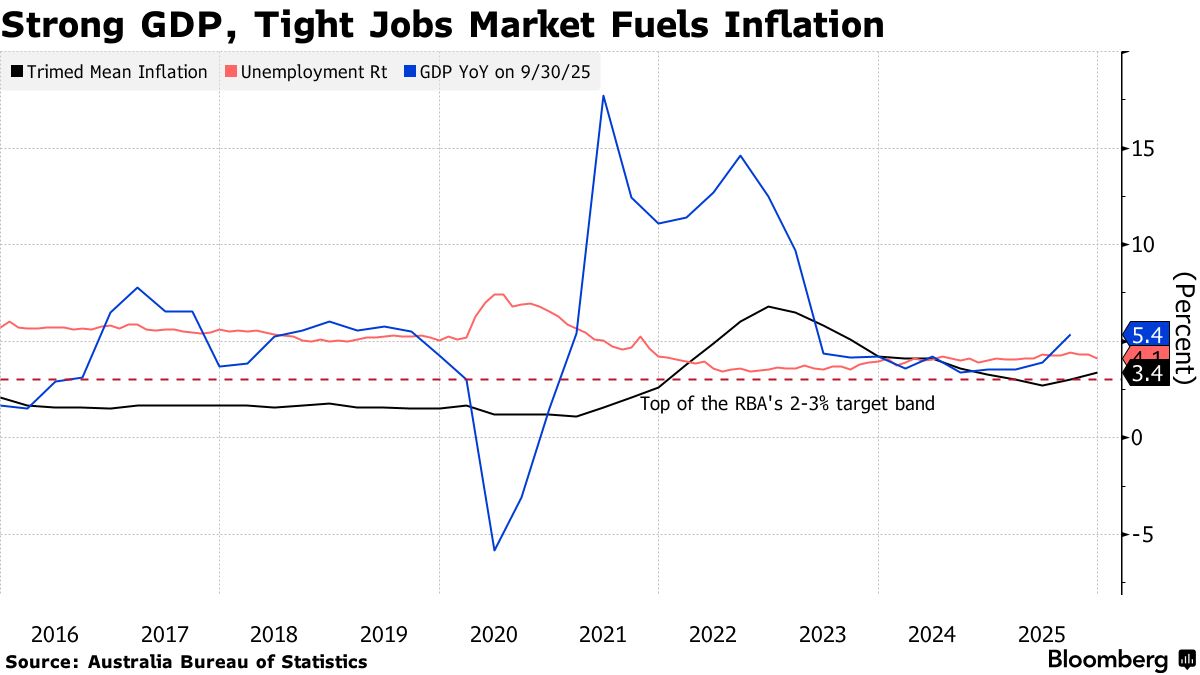
Economic growth began picking up around the middle of last year. While government activity has eased in recent quarters, public spending remains historically high at nearly 27% of gross domestic product.
At the same time, there are signs of an upswing in the private sector, with most of it focused on artificial intelligence and energy infrastructure. The labor market remains tight as well, with unemployment hovering near a historically low level at 4.1%.
Adding further fuel to prices, an upturn in the global economy has boosted prospects for Australia, which is among the top suppliers of iron ore, coal, copper, gold and some critical minerals.
All that has refueled inflation in an economy that is struggling with some of the weakest productivity in the developed world. Indeed, Australia’s potential growth is so low now that, at 2%, it’s been reached early in the business cycle.
Inflation last quarter came in at 3.4%, overshooting the top of the RBA’s 2-3% target.
The government is due to release a budget in May, and pressure is mounting on it to rein in spending and tackle productivity-enhancing measures.
“To avoid the next hike, the RBA would need to see credible demand cooling from government policy or housing credit tightening, not just better CPI results,” said Karol Binkowski, a senior lecturer at Macquarie University. “None of these steps would be popular, but without them, the pressure remains on interest rates to do the heavy lifting.”
Australia’s Productivity Is Lagging Peers
Labor productivity index, 2019Q1 = 100
Source: Organization for Economic Cooperation and Development Economic Outlook database
At her press conference this week after the rate hike, Bullock was at pains to avoid addressing whether government spending was fueling inflation. She said private demand was “much stronger” than expected and, together with supply constraints, was pushing prices higher.
“I’m not going to comment on fiscal policy because it’s an independent policy,” she said. It’s a dodge she’s taken before, and an unusual one given how influential government spending is on whether she succeeds in her role as central bank boss.
Still, for markets and policymakers abroad, Australia’s experience highlights a challenge in the post-Covid inflation era: price pressures are increasingly being driven by demand overheating, as well as by structural constraints and fiscal momentum. Anemic productivity growth exacerbates those issues.
That’s a problem the Organisation for Economic Co-operation and Development noted in its latest survey for Australia. It pointed to a strong inflow of migrants between 2022 and 2024, who tend to have lower wages and productivity than native-born workers, and an expansion of the government sector.
It also mentioned a general lack of innovation and dynamism.
Commonwealth Bank of Australia’s Chief Economist Luke Yeaman, a former deputy secretary at the Treasury, expects the government will face pressure to do “more substantive economic reforms and deeper cuts” to public spending.
However, given the “huge structural spending pressures in health, disabilities and defense,” Yeaman said, “overall spending levels are unlikely to shift much.”
— With assistance from James Mayger

Follow all new stories by Swati Pandey
View this Bloomberg article CLICK HERE
 Media Air Base, LLC
Leave a comment