Is there still money to be made in the gold rush?
Prices are up 85% in a year, but is it too late to buy in to this supposedly safe haven? We look at the risks and potential rewards
George Nixon, Senior Money Reporter
Tuesday January 27 2026, 3.30pm GMT, The Times
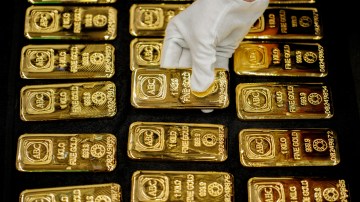
Gold may be at a record high, but it has further to go, analysts have predicted. Its price is up 85 per cent over the past year, driven by investors looking for a safe haven amid global uncertainty.
It hit more than $5,000 a troy ounce on Monday, helped by the fact that rising government debt has led other traditional safe haven assets, such as government bonds, to fall out of favour.
Analysts at the investment bank Deutsche Bank suggested that a price of $6,000 an ounce was “achievable with a weaker dollar this year”. But should you join the gold rush? Here’s what you need to consider.
Why gold goes up
“Gold has become the go-to for risk-averse investors, boosted by a falling dollar, which has made it cheaper to buy, greater take-up by central banks and a surge of speculative interest from retail investors,” said Tom Stevenson from the investment firm Fidelity after the best week for gold since the 2008 financial crisis.
But gold does not pay any income or dividends and its value is not quantifiable in the same way as shares in a company, where prices are based on earnings or growth forecasts.
Laith Khalaf from the investment platform AJ Bell said: “There is little in the way of underlying fundamentals to provide a meaningful valuation for gold. Its price is therefore highly driven by sentiment, unpredictable macroeconomic tides, and for technical traders, by pretty shapes on a chart.”
Gold has traditionally performed well in times of uncertainty because it is a physical asset with a finite supply. It is popular in times of high inflation or high levels of government debt, which can harm the values of other “safe haven” assets such as bonds. High levels of borrowing means more bonds being issued by governments, which can lower the value of those already in circulation. The value of the fixed income that bonds pay can also be eroded when inflation is high.
How to buy gold
Rather than squirrelling away bullion bars in an underground vault, you can invest in gold without actually owning the real thing.
You can invest in cheap funds that track its price. AJ Bell’s most popular is the iShares Physical Gold exchange-traded commodity, which is up 14.8 per cent this year and an average of 33.3 per cent a year over the past three years. It has a 0.12 per cent annual fee. These funds either buy gold outright, or use complicated financial products known as derivatives to bet on its price.
‘No one is taking it away, nobody’s taxing it’: why women are buying gold
You could also buy shares in companies that mine gold and other precious metals, or funds that invest in mining companies. These have an added bonus in that they can sometimes pay dividends.
Darius McDermott from the investment research firm FundCalibre said: “Historically, miners tend to lag bullion in the early stages of precious metal rallies, only catching up later as higher prices translate into stronger margins, cash flows and balance-sheet improvement. This pattern appears to be repeating.”
McDermott suggested the WS Amati Strategic Metals fund, or the BlackRock World Mining trust. WS Amati’s top ten holdings include the Canadian mining firms Eldorado Gold and G Mining Ventures. The fund is up 192.5 per cent over the past year and 29.8 per cent a year over the past three, although the annual charge at 1 per cent a year is considerable.
The BlackRock trust invests in the world’s big miners, including Rio Tinto, Anglo American and BHP, and is up 115 per cent over the past year and 16.4 per cent a year over the past three. It has a 0.95 per cent annual fee.
Another option is a cheap tracker fund, which uses algorithms to mimic the holdings and performance of an index of stocks. BlackRock’s iShares MSCI Global Metals & Mining Producers exchange traded fund (ETF) returned 50.7 per cent last year and an average of 11.5 per cent a year over the past three years. Its top ten holdings include BHP, Rio Tinto and the Swiss miner Glencore and it has a fee of 0.39 per cent.
If you prefer to buy physical gold you could use an online retailer such as BullionVault, which sells gold bars and will store them for you in a vault. The official coinmaker, the Royal Mint, also sells precious coins and bars. Coins have the added advantage of being classed as legal tender, so they are exempt from capital gains tax. You can also buy gold bars and sovereign coins from the wholesale retailer Costco.
How high will it go?
There have been warnings, notably from the Bank for International Settlements, which connects the world’s central banks, that gold could be in bubble territory and so heading for a dramatic collapse. But some analysts suggest there is further to go.
The Trump administration is expected to continue to push for a weaker dollar in the hope of making US exports cheaper. The “dollar index”, which compares the US currency with a basket of others, is down 9.8 per cent over the past year.
The president has also put pressure on the US Federal Reserve to cut interest rates further. Central banks being subject to political pressure tends to boost gold as investors look for assets that are free of political influence, while the banks themselves have also been buying gold. The central banks of Poland, Kazakhstan and Brazil invested heavily last year.
Fear of missing out drives gold to record highs
However, Khalaf warned: “Investments that have done so well are often crowded trades and could be due a correction. While gold is often touted as the ultimate safe haven because it’s free from government interference, it is volatile and drops in price can be painful for investors. Those with a cautious disposition and a low tolerance for losses should take note.
“A typical balanced portfolio shouldn’t have more than 5 to 10 per cent invested in gold, as catastrophe insurance.”
Related articles

Should you be worried about a cryptocurrency sell-off?
George Nixon, Senior Money Reporter

Talk of gold rush returning to Scottish Highlands
Greig Cameron, Scottish Business Editor
View this The Times (UK) article CLICK HERE
 Media Air Base, LLC
Leave a comment