Trump Ushers in the Era of ‘Big America’—Around the World and Here at Home, Too
By Andy SerwerFollow
Jan 23, 2026, 12:11 pm EST
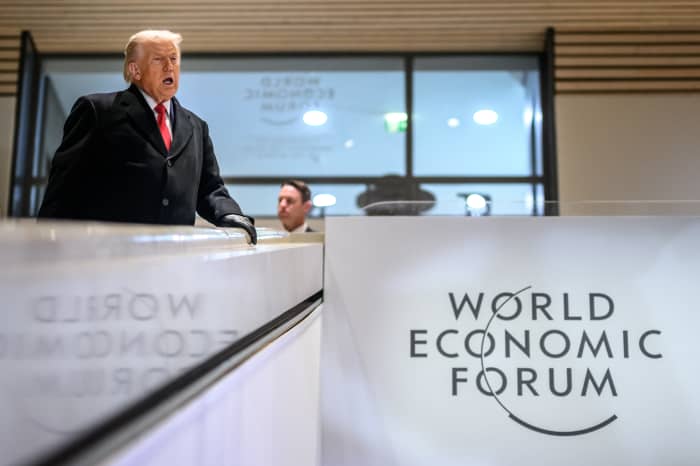
President Donald Trump at the World Economic Forum annual meeting in Davos, Switzerland. (Fabrice COFFRINI / AFP via Getty Images)
It was quite the week for Donald Trump, even by his standards, as he went full King of the World mode at the World Economic Forum’s annual meeting in Davos, Switzerland. For a president who seems to relish being in the spotlight and changing things up as much as he does, small wonder he said the trip was “incredible.” As for any resulting political and economic consequences, we’ll have to see, won’t we?
The simple truth is the U.S. government under Trump is flexing its muscles to an almost unprecedented degree. “Big America,” as I’m calling it, is a kind of unstated but very real mandate which applies to both internal and external machinations and policies being pursued by the Trump administration. It’s a form of personal political maximalism that Americans aren’t used to.
Yes, it’s ironic that Big America comes from a Republican, a party that for decades has framed itself as desiring a small federal government, and that Trump campaigned in part on extricating America from foreign entanglements, but that’s beside the point. The reality is that as we approach the 250th anniversary of our nation, we have the most active federal government in our history (and per usual when this occurs, power is derived from the executive branch).
I barely need to spell any of this out, what with Trump’s raid into Venezuela, his dogged intention to control Greenland’s sovereignty to one degree or another, and his creation of the Board of Peace (with him as chairman), arguably to supersede the United Nations—all occurring just this month. Threats, actions, and suggestions of action against other countries are almost too many to enumerate—though on one front the Military Times has done just that, reporting that Trump “has presided over a rapid surge of U.S. military activity abroad since returning to the Oval Office.” Trump, the MT says, has overseen at least 626 airstrikes in some seven countries during the first year of his second term, as opposed to President Joe Biden, who launched a total of 555 strikes over his four-year term.
That’s the external.
Internally, new measures from the White House touch on countless facets of our economy and society, from investing directly in companies such as U.S. Steel and Intel
INTC-17.03% to promulgating new laws on housing and credit cards, punishing law firms and universities, and deploying ICE in cities across the country.
The combination of these domestic and external actions, as well as the very personal nature of these interventions by Trump, puts America on a course the likes of which we’ve never seen before.
Of course, we’ve had some prior experience. On the foreign policy front, the U.S. went through a New Imperialism Era in the late 19th and early 20th centuries, personified by Teddy Roosevelt with his Big Stick diplomacy and the Roosevelt Corollary (an extension of the Monroe Doctrine). America secured the Panama Canal, Puerto Rico, Guam, and the Philippines, as well as Hawaii, during those years.
As for domestic policy, the high-water mark of federal government power previously was coincidently during the tenure of TR’s distant cousin, Franklin Delano Roosevelt, in the New Deal. FDR felt compelled to dramatically reconfigure our economic norms at the time to pull us out of the Great Depression.
Today, we arguably have the Roosevelts squared—the external muscularity of Theodore and the internal big government of Franklin mashed up together into Big America—shaped by Donald Trump with all of his whims, fancies, and obsessions. (There are of course all kinds of differences between the Roosevelts and Trump. My point is they all oversaw a hyperactive executive branch.)
Trump’s agenda isn’t just expansive, it’s unrelenting, jumping from domestic to foreign issues day by day, hour by hour, Truth Social post by Truth Social post, blasting a group of companies and their CEOs one minute, and then NATO and the news media the next. You may vehemently disagree with the direction and/or quality of his moves, but the quantity is undeniable. Love it or hate it, many Americans—indeed many citizens of the world—can’t look away.
It’s worth noting that the world is also processing Big China and to a lesser degree Big Russia and Big India. But Europe? It’s not following the strongman playbook, and to a degree is caught between Putin and Trump, with Exhibit A being Ukraine. It’s striking how much these geopolitical phases of the moon—in this case nationalistic tendencies—run in cycles. Decades of globalism now being reversed remind us that human nature can be lemming-like, to put it bluntly (or perhaps gently).
At Davos, where I was this week, I can tell you that Trump and Big America simply dominated the conversation and proceedings from start to finish. “This will be the largest U.S. delegation ever seen in Davos,” WEF CEO Børge Brende said before the conference even began. DEI, ESG, and climate change, perennial mainstays of previous meetings, were almost completely absent from the agenda. Even AI took a back seat to speculating about Trump—what he would say, what he meant by what he said, and what he would say next.
“Trump is in all of our heads,” the former CEO of one of Silicon Valley’s largest companies told me, who declined to be identified for fear of offending the president by saying…only that.
I had seen Trump speak at Davos in 2020, which was memorable but nothing like this. Back then the audience in Davos’s big Congress Center hall was full, but it seemed like everyone got a seat. This year Trump whipped the attendees into a frenzy before he arrived, with hundreds lining up for some two hours to see him speak, only to be stampeded aside by others who pushed their way in from the sides. (Yours truly didn’t make it in and had to view the speech in one of the overflow rooms, where there was also a crush to watch.)
In the room where I watched (capacity 175), a contingent of mostly European business leaders listened silently as Trump bragged about the U.S. and bashed Europe and Biden. They laughed at him when he spoke about Venezuela’s predicament. (“Venezuela is going to do fantastically well. We appreciate all of the cooperation we’ve been given.”)
“But you know what,” said a top executive of a well-known global company based in Paris, “the Europeans went from laughing at him to laughing with him,” pointing to as an example Trump’s ranting about windmills. (“Windmills all over the place. Destroy your land, destroy your land. Every time that goes around, you lose $1,000. You’re supposed to make money with energy, not lose money.”)
Also, for the first time, the U.S. had a headquarters in Davos, the result of a public-private partnership spearheaded by hockey-player-turned-investor and Davos regular Richard Strombeck, who created USA House in the Freie Evangelische Gemeinde Church of Davos.
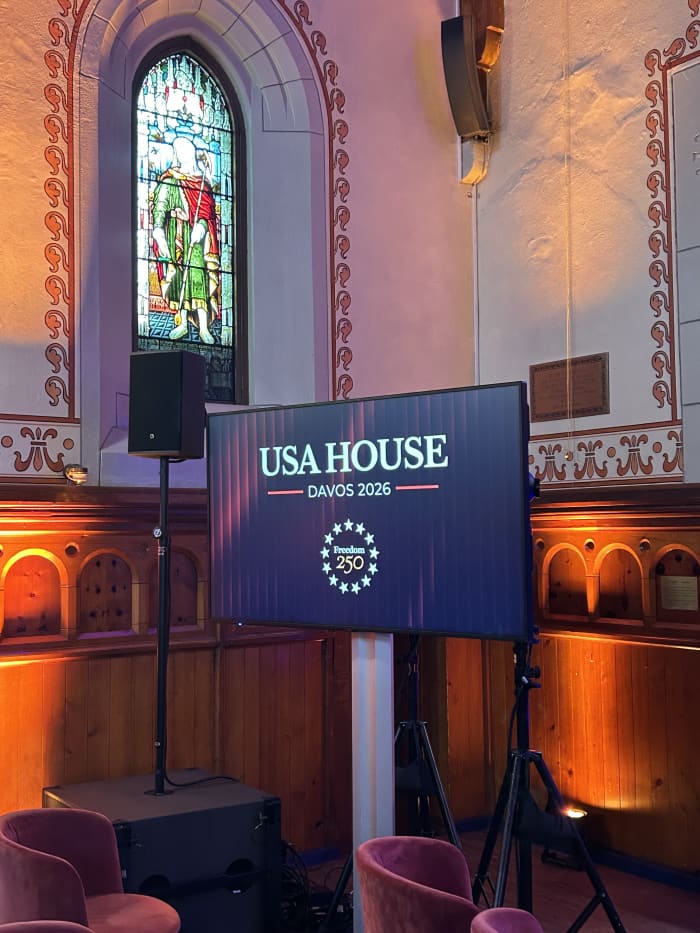
Inside the USA House during the World Economic Forum annual meeting. Photo: (Andy Serwer)
Founded in 1882, the congregation then consisted almost entirely of tuberculosis patients, who came to Davos believing the mountain air might help them. (Thomas Mann’s masterpiece, The Magic Mountain, was based in a TB sanatorium in Davos.) Today the church’s website says: “We want to live out our church life in a contemporary way, grounded in biblical principles! Our vision is to live in a community shaped by Jesus and for Davos to experience his love.”
This week, though, the church was festooned inside and out with red, white, and blue and “Freedom 250” signage coupled with some don’t-mess-with looking eagles. Inside the modest interior, screens crediting sponsors Pfizer, McKinsey, Microsoft, and C3.ai were juxtaposed with jewel-toned stained-glass windows. (Paradoxes are apparently nothing new for Church FEG of Davos, as during the previous few WEF meetings it has been referred to as “the Sanctuary,” a frequently used venue to host crypto and blockchain events.)
One of the biggest takeaways from Trump’s Davos sojourn was him serving up a Swiss TACO (stands for “Trump Always Chickens Out”), in that he walked back tariffs on Europe and said he would not resort to invading Greenland, contrary to what he said previously, which made the market tank. Now he says he has an “amazing” Greenland deal in the works. And of course the market has been up since.
And almost as an aside this week, Trump made good on his threat to sue JPMorgan Chase
JPM-1.95% and its CEO Jamie Dimon for some $5 billion, alleging JPM debanked him. The bank says the suit has no merit. (Though Dimon was also at Davos, holding court at his traditional cocktail party, the world may not be big enough for both Trump and Dimon.)
So where does Trump go from here? The Roman, British, and Spanish empires all lasted 400 to 500 years. Fascist regimes of the last century were much shorter-lived, fortunately. Our New Imperialism Era went from the late 1890s to the outbreak of World War I in 1914. The New Deal spanned 1933 to 1941. As for this new Big America? Who knows? Trump has three years left in his term. We will see if Big America outlasts him.
Consider that Trump has the biggest economy in the world, the biggest army in the world, the biggest law firm (the Department of Justice) in the world, and the biggest pot of capital in the world at his disposal. America has the world’s best universities, nearly unmatched natural resources, and the world’s reserve currency (though with the move gold has made over the past two years—from $2,040 an ounce to $4,900—the notion that the original reserve currency is recapturing that position, is shall we say, gaining currency).
Unlike any other president before him, Trump is looking to exploit and leverage America’s assets as much as he can. And he’s looking to do so exactly the way he wants to. Big, and in his image.
Write to Andy Serwer at andy.serwer@barrons.com
View this Barron’s article CLICK HERE
 Media Air Base, LLC
Leave a comment