Trump’s Stormy First Year Has Made Us Richer. But Will We Pay Someday?
Jan 20, 2026, 1:00 am EST
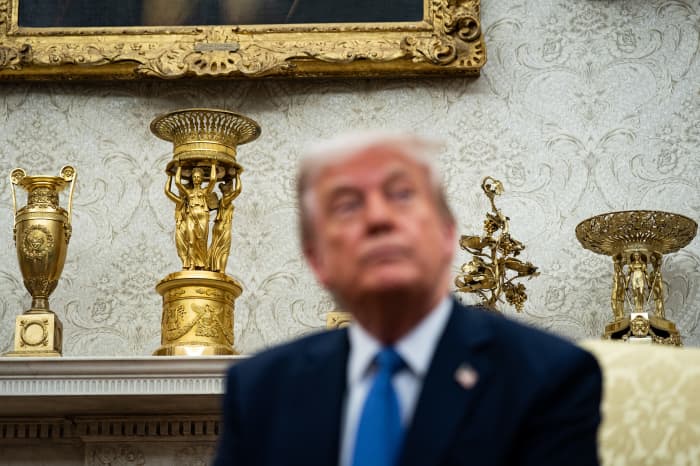
President Donald Trump has embellished the White House with gold, including the Oval Office. (Al Drago/Bloomberg)
President Donald Trump promised a golden age in his second presidency, which began on Jan. 20, 2025. Exactly a year in, he has delivered, although perhaps not in the way he meant.
Trump has bedecked the White House with gold decor. “Best Oval Office ever,” he bragged in September.
Investors have also taken a shine to gold, and bid up its price by nearly 70% in the past year. That historic rally is double-sided, though.
On one hand, it reflects applause for Trump 2.0, in particular the president’s economic agenda. On the other, it signals growing worries about the future, including Trump’s legacy.
The price of gold
GC00+2.89%, like other assets, is driven by many factors. But the past year’s run-up clearly reflects a measure of speculative exuberance that isn’t limited only to precious metals.
Stocks have rallied, reflecting enthusiasm for Trump’s economic policies, or at least the parts that lean on tax cuts, deregulation, and a push for lower interest rates, which have spurred growth without sparking increased inflation, and kept job losses relatively low.
The Dow Jones Industrial Average
DJIA-0.17% is up 13.5% since Inauguration Day. The S&P 500SPX-0.06% has gained 15.7%, and the Nasdaq CompositeCOMP-0.06%, 19.8%.
But many investors aren’t looking to gold just to make a buck. The yellow metal has become the ultimate insurance policy in a world that often seems out of control. Fears about renewed inflation, war, and political instability have all been channeled into gold. It is the asset class that arguably most clearly reflects anxiety about Trump’s behavior and America’s standing in the world.
Treasury Secretary Scott Bessent almost certainly would point to another asset as the country’s barometer. He has said he and the president are focused on the 10-year Treasury
TY00-0.22% yield, the benchmark for interest rates that regular Americans pay on their mortgages, car loans, and other debt.
Judged by that yardstick, the administration has done well. The 10-year yield, which reflects investors’ expectations for growth and inflation, is down about four-tenths of a percentage point, to about 4.2%.
Some investment strategists warned of a “bond riot” when Trump became president, arguing that investors would demand higher yields as compensation for escalating inflation as the budget deficit inexorably rose. But the bond vigilantes have been held at bay.
Yes, there were problems in year one. Trump proclaimed “Liberation Day” on April 2, surprising the world with sky-high tariffs on imports.
The stock market plummeted and the Treasury market nearly seized up as hedge funds unwound suddenly losing trades. Bond traders made urgent calls to the Treasury to make sure the administration knew the risk it was taking.
Trump temporarily paused the tariff rollout and acknowledged the Treasury worries. “The bond market is very tricky,” he said.
But that tricky market bounced back even after Trump restarted his tariff plans. Now there’s “nothing to talk about” in the Treasury market, said Amar Reganti, fixed income strategist at Hartford Funds.
The 10-year yield has settled into a range of roughly 4% and 4.2%.
“A range-bound Treasury is a really good thing,” said Reganti. “It tells the private sector that they can expect things to continue in the fashion that they have been.”
Businesses can also expect tariffs to stick around, although many aren’t thrilled about that.
“The tariffs have been overwhelmingly borne by domestic businesses and consumers, rather than by foreign producers,” John Williams, president of the Federal Reserve Bank of New York, told the Council on Foreign Relations just days ago.
Williams estimates tariffs have added about a half-point to the inflation rate of 2.7%.
Still, tariffs are the outlier in an economic policy that is otherwise turning up the dial toward growth. Families will soon see the benefits of backdated income-tax cuts, while businesses enjoy the benefits of slashed regulation.
The tax cuts aren’t free. The national debt is now 100% of gross domestic product, and rising. The deficit is at 6% of GDP. But there are benefits, too.
“It’s very hard to have a recession when you are running mid-single-digit deficits consistently,” Reganti said.
The Federal Reserve is playing its part. Fed policymakers cut the federal-funds rate target range by three-quarters of a point, to 3.50% to 3.75%, in last year’s second half to support a weakening labor market. The U.S. created just 50,000 jobs in December.
One of the defining events of 2026 will come when Trump announces his pick to replace Fed Chair Jerome Powell, whose term ends May 15. Powell can choose to remain a voting member of the Federal Open Market Committee until January 2028.
The president probably will announce his nomination before the end of January, Bessent has said. The Senate must confirm his nominee.
Whomever Trump chooses will step into a difficult role: Concerns about the Fed’s independence have become paramount as Trump publicly berates Powell for his failure to cut interest rates more. All the contenders have said they agree with Trump’s demand for lower rates.
But Powell’s successor can’t be sure that Trump won’t turn on him if the Fed doesn’t cut rates fast or far enough.
The president’s vilification of the central bank includes an attempt to fire one Fed governor over allegations of mortgage fraud, which she denies. And federal prosecutors have launched an investigation into Powell that he denounces as a pretext for assaulting his independence.
The administration has big plans for a post-Powell Fed. Bessent wants the Fed to “foam the runway” for the administration. That would mean lowering rates to allow the government to run the economy hot and pay down debt.
Doing all of the above would raise the risk of reigniting inflation, but that would take a while, and the 2026 midterm elections are approaching. The Democrats benefited in 2022 under President Joe Biden from an injection of cash into the economy, only to lose control in 2024 after stimulus gave way to inflation. Trump is following a similar strategy, though presumably hoping for a better result.
The midterms will be a referendum on Trump’s presidency, from his expansive economic policies to his harsh immigration policies and his unorthodox and highly personal conduct of foreign affairs.
Trump insists Republicans will dominate, telling Reuters that the administration has done so much that “when you think of it, we shouldn’t even have an election.”
The national mood suggests otherwise. Many more Americans disapprove of Trump than approve of him; his approval is underwater by about 13 points, according to the polling average produced by the data journalist G. Elliot Morris. His rating on jobs and the economy is negative 16.5 points.
The issue he is strongest on is immigration, which is negative by only 5.8 points. Americans viewed him positively on that issue after Trump moved decisively to close the southern border, but soured as immigration raids moved into homes and businesses.
Still, a strong economy can overcome a lot of worry, and Trump is willing to put the power of the presidency behind making sure his voters feel good.
Trump has given himself extraordinary power over the world’s oil production, building up friendly relations with the leaders of Saudi Arabia and other Middle East oil producers while declaring himself in charge of Venezuela’s vast oil reserves. With oil resting comfortably under $60 a barrel, Trump can avoid the gas-price sticker shock that doomed Democrats.
But whether Trump can hold it all together is the great question of his presidency. The Supreme Court may rein in his tariffs and his attempts to control the Fed, while world leaders are starting to find ways to work around Trump. His attempts to seize Greenland appear to be galvanizing European allies against him in unprecedented ways.
The U.S. thrived for decades by opening up its economy and markets to the world. Trump believes that was a mistake, and is working to single-handedly close off the hemisphere around the U.S. If he can do so while delivering rewarding jobs, a rising stock market, and cheap gas, voters may back his efforts, or at least shrug them off.
But the 56 record highs in gold in the past 12 months suggest there is more than a little anxiety on Wall Street about whether Trump will succeed. Suffice it to say that if the next three years are anything like the last, there are probably many more highs to come.
Write to Matt Peterson at matt.peterson@dowjones.com
News For You
Bank Earnings Delivered. Wall Street Ain’t Seen Nothin’ Yet.
Barron’s

Trump Links Greenland Threats to Missing Out on Nobel Prize
WSJ

A Wall Street Legend and His Penthouse Sex Dungeon
WSJ

S&P 500 has gained 16% in Trump’s first year back in office. How that compares with other presidents.
MarketWatch

Musk’s xAI Raises Questions About Acceptable AI
WSJ
Go to WSJ+ Dashboard Explore WSJ+ Marketplace
Stocks Tumble, Dollar Drops. How Trump’s Greenland Tariff Threats Are Hitting Markets.
Jan 19, 2026, 5:33 am EST
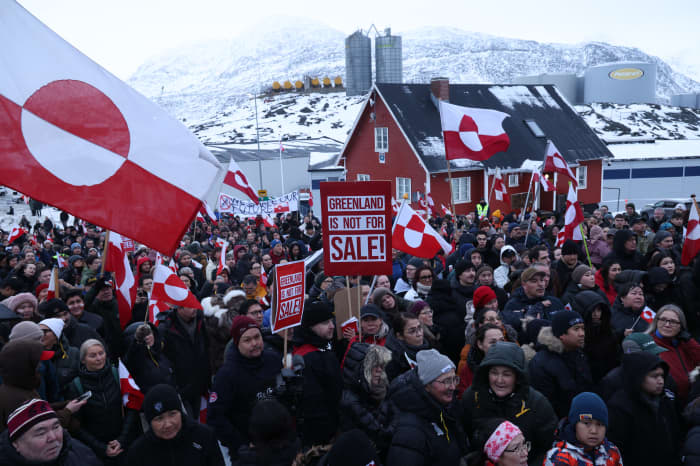
People hold Greenland flags and placards as they protest against U.S. President Donald Trump’s announced intent to acquire the island. (Sean Gallup/Getty Images.
Key Points
About This Summary
- European stocks fell, with the Stoxx 600 dropping 1% and the CAC 40 tumbling 1.4%, after new tariff threats.
- Gold futures rose 1.8% to $4,677 an ounce and silver futures jumped 5% to nearly $93 an ounce.
- President Donald Trump threatened a 10% tariff on eight NATO nations starting Feb. 1, increasing to 25% on June 1, 2026.
European stocks fell and gold and silver surged to new highs after President Donald Trump threatened to impose tariffs on eight NATO nations as the White House pushes to acquire Greenland.
Europe’s flagship Stoxx 600
SXXP-0.96% index dropped 1% in early trading. Frankfurt’s DaxDAX-1.08% plunged 1.2%, London’s FTSE 100UKX-1.10% slipped 0.4%, and Paris’s CAC 40PX1-0.99% tumbled 1.4%.
Precious metals rallied to records. Gold futures rose 1.8% to $4,677 an ounce, and Silver futures jumped 5% to just under $93 an ounce.FTSE 100Stoxx 600DaxCAC 40Jan. 16Jan. 19-2.5-2.0-1.5-1.0-0.500.5%
From Feb. 1, Denmark, Norway, Sweden, France, Germany, Finland, The Netherlands, and the U.K. will be subject to “a 10% Tariff on any and all goods sent to the United States of America,” Trump said on Saturday in a Truth Social post.
“On June 1st, 2026, the Tariff will be increased to 25%. This Tariff will be due and payable until such time as a Deal is reached for the Complete and Total purchase of Greenland,” he added.
The moves on Monday suggest Trump’s tariff threats are rattling the market, although analysts noted that the selloff was relatively small compared with April 2025, when the White House’s sweeping “reciprocal” levies caused stocks to plummet.
“The market reaction to this escalation has been relatively muted compared to the post-Liberation Day sell-off seen last April,” Hargreaves Lansdown head of equity research Derren Nathan said. “Given the President’s history of dramatic threats and last-minute stand-downs, investors may be pricing in a generous degree of bluff in this high-stakes poker game.”
Asian stocks closed lower as sentiment soured. Hong Kong’s Hang Seng dropped 1.1% and Tokyo’s Nikkei 225 fell 0.3%.
South Korea’s KOSPI bucked the trend with a 1.3% gain, boosted by a rally in chip-making stocks after Micron Technology
MU+7.76% unveiled plans to buy a facility in Taiwan.
The dollar slipped 0.2% against a weighted basket of its peers following Trump’s tariff threat. U.S. stock and bond markets were closed for Martin Luther King Jr. Day.
Write to George Glover at george.glover@dowjones.com
View these Barron’s articles CLICK HERE
 Media Air Base, LLC
Leave a comment