The stock market has peaked, and a three-year downturn is starting, says this veteran strategist
Global liquidity is drying up and this has bearish implications for stocks.
By Jules Rimmer
Published: Nov. 21, 2025 at 6:04 a.m. ET
CrossBorder Capital strategist thinks a sustained downturn is beginning and that gold and commodities are the best way to protect one’s portfolio Photo: Getty Images
Referenced Symbols
The global liquidity cycle — best described as the flow of funds through world financial markets — is drying up and this is bearish for equities, says a veteran strategist.
“We’ve been in a bit of a bubble and liquidity is basically being pulled away,” said Michael Howell, chief executive of CrossBorder Capital, a London research firm, in an interview with hedge fund manager Erik Townsend on the MacroVoices podcast. He thinks the speculative phase of the U.S. market has peaked, and there’s going to be a downturn for stocks that could last two or three years.
Howell, whose early career featured stints at Salomon Brothers and Barings before he established his own well-regarded research boutique, also believes the only way for governments to deal with their debt problems is by printing money, and so gold
and bitcoin
are the best ways to hedge against the inflation that inevitably entails. Howell predicts gold at $10,000 per ounce by the mid 2030s.
Howell articulated his theory of the global liquidity cycle that he believes broadly dictates markets’ behavior. His research finds that global liquidity runs in cycles of roughly five years with this last one starting around the time of the global pandemic in 2020.
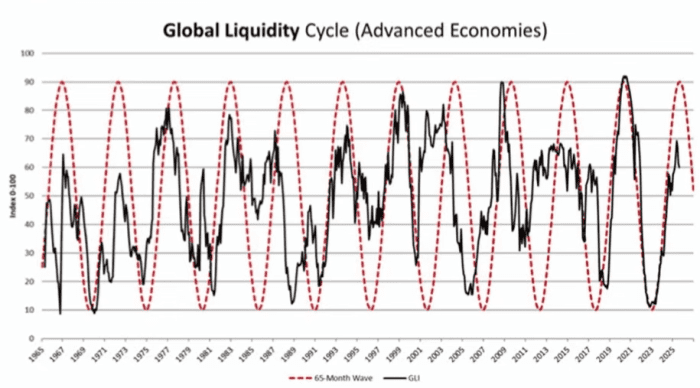
Global liquidity cycles tend to last about five or five and a half years and we are very late into this cycle that began in 2020.
His explanation for this time frame is that it approximates the debt refinancing cycle because the weighted average maturity of that debt is just over five years. Howell estimates there is $350 trillion of debt globally, and so roughly $70 trillion needs refinancing annually. That’s not far off from the $338 trillion global debt estimate of the Institute of International Finance.
This withdrawal of liquidity is already causing some tensions in the repo market that have not been witnessed since 2019 and this persuades Howell that stocks are not the right asset allocation at this juncture. He says there’s a six-month lag between liquidity drying up and the effects being felt on the S&P 500
Fed liquidity has important implications for the S&P 500 – with a lag
He notes in previous cycles it is commodities and mining stocks that do best in the leg when liquidity is declining.
Howell does not subscribe to the theory aired in markets of late that the government shutdown was responsible for the fall in liquidity and risk assets, but he does think the government is facing a difficult dilemma at present in that it must decide whether to, “try and goose Wall Street or do they try and put more stimulus into Main Street?”
Howell calculates that with the mid-terms less than a year away, the Trump administration will opt for the latter. President Donald Trump already has mused about a $2,000 per household check.
The $350 trillion debt mountain and the difficulty in financing it convinces Howell that “the dreaded words” quantitative easing may well be back on the agenda for central banks globally in 2026. He cites the example of Japan and China where huge debt issuance caused monetary deflation to which their central banks responded by allowing their currencies to devalue. Counteracting this fiat currency debasement explains why Howell thinks “it’s not just a question of gold or bitcoin; it’s a question of gold and bitcoin.”
It should be noted that bitcoin has dropped some 30% from its record high.
Partner Center
News For You

These Stocks Moved the Most Today: Nvidia, Oracle, Alphabet, Strategy, Intuit, Lilly, Gap, Elastic, Veeva, and More
Barron’s
14 hours ago

The Bull’s Wild Ride: What We Have Here Is A Worrywart Market
Barron’s
8 hours ago

Trump Says He Wants Ukraine’s Answer on Peace Plan by Thursday
WSJ
4 hours ago

Are We There Yet? Stocks Are Halfway to a Correction but Haven’t Capitulated.
Barron’s
21 hours ago

An MIT Student Awed Top Economists With His AI Study—Then It All Fell Apart
WSJ
4 hours ago
Go to WSJ+ DashboardExplore WSJ+ Marketplace
About the Author

Jules Rimmer is a markets reporter in London. Rimmer spent more than 30 years as a trader and stockbroker in financial markets, starting at Salomon Brothers in the Liar’s Poker era, taking in ING Barings, Jefferies and ending it in emerging markets at Investec. He hung up his headset and pivoted to journalism in 2021.
View this MarketWatch article CLICK HERE
 Media Air Base, LLC
Leave a comment