Supreme Court Will Hear Trump Tariff Case. It Matters for the Economy.
Nov 05, 2025, 1:30 am EST
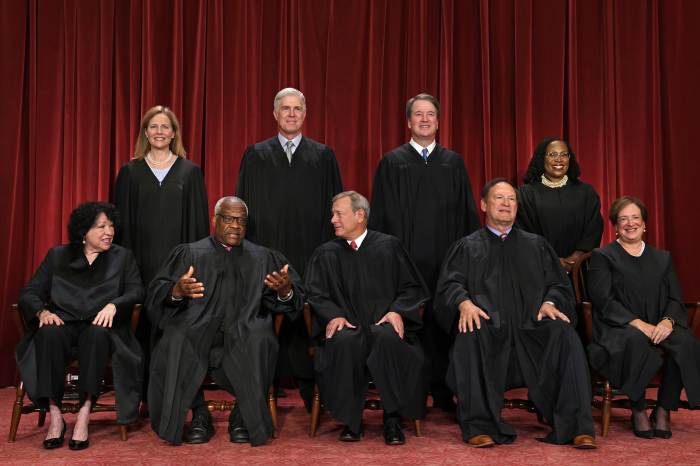
The nine justices of the Supreme Court. (Alex Wong/Getty Images)
Key Points
About This Summary
- The Supreme Court will hear arguments on President Trump’s use of tariffs, which lower courts ruled exceeded his authority under the International Economic Emergency Powers Act.
- A ruling against the tariffs could create bond market volatility by questioning billions in revenue that helped offset the deficit from a tax and spending bill.
- The court may find a middle ground, allowing some tariffs under the act but imposing limits on their use, distinguishing between broad and fentanyl-related levies.
The Supreme Court will hear 80 minutes of oral arguments Wednesday on President Donald Trump’s use of tariffs in a case with ramifications for presidential power, the economy and the country’s fiscal health.
Lower courts ruled that Trump overstepped his authority in using the International Economic Emergency Powers Act to impose tariffs on the majority of America’s trading partners and additional levies related to fentanyl flows on China, Canada and Mexico.
Trump has also threatened tariffs, including 10% on Canada for an anti-tariff ad run by Ontario and a 40% tariff against Brazil, citing the criminal prosecution of former President and Trump ally Jair Bolsonaro.
At issue are a spate of tariffs on trading partners, the revenue that they have brought in so far and the myriad preliminary trade agreements the U.S. has struck with countries in recent weeks. In a social media post, President Donald Trump said the Supreme Court case is “literally, LIFE OR DEATH for our Country,” adding that without a victory the U.S. is “virtually defenseless against other Countries who have, for years, taken advantage of us.” He partly attributed the stock market’s record highs to the economic security created by tariffs and trade deals negotiated by his administration.
If the Supreme Court rules against the tariffs, the administration has other options—albeit ones with more restrictions—to keep tariffs in the mix. For example, it could impose more tariffs on China through the Section 301 investigation it opened in its first term and it could widen the sectoral tariffs already in place under Section 232. Other avenues are also possible, though some come with limits on how high or for how long tariffs could be in place.
A Supreme Court decision that finds the tariffs unlawful could also create volatility in the bond market. It would call into question the billions the U.S. has added to its coffers from tariffs, helping offset some of the deficit from the tax and spending bill passed earlier in the year. Pantheon Macro estimates the U.S. has collected $34 billion this month in customs and excise tax—on track to $400 billion over a year in tariff revenue.
The court could also land somewhere in the middle between fully agreeing with the administration’s use of tariffs and ruling that the International Economic Emergency Powers Act statutory language doesn’t allow tariffs at all. The court could instead find that while the act can authorize some tariffs, there are limits on when they can be used, with distinctions drawn between the broad-based reciprocal tariffs and those Trump imposed to curb fentanyl flows.
“I think this will be a very close decision, and during the argument I’ll be watching for the kinds of questions that Chief Justice Roberts, Justice Barrett, and Justice Kavanaugh pose to the parties,” says Ryan Majerus, a partner at King & Spalding who also has served as senior counsel for Supreme Court and appellate litigation for the U.S. Department of Agriculture. These three conservative judges are considered most likely to be the swing votes in any decision.
Betting markets suggest a 50% to 60% shot the tariffs are struck down by the court. Lawyers expect much debate around the “Major Questions” doctrine and whether Congress needed to explicitly grant the power to the president to use tariffs.
Here, a debate about the word “tariffs” could offer some insight. The more the court digs into why the word tariffs isn’t included in the act even though it is used in other statutes that preceded it, the more it would be indicative of skepticism about the use of the emergency powers for tariffs, says Marc Busch, an international trade expert at Georgetown McDonough’s Baratta Center for Global Business.
The administration has argued recently that the act allows tariffs as a “regulatory tool” and that the levies it imposed are a form of regulation—like a quota or embargo—rather than a tax aimed at raising revenue, Busch says. As a result, Monica Gorman, managing director of Cromwell Global Advisors, says she is looking for whether justices take a similar view or see tariffs as a tax—a power that lies with Congress.
Also worth watching: how much the justices care about the reasoning for the tariffs imposed under the emergency powers act. Detailed questions about the various declared national emergencies could suggest a willingness to put limits on the presidential emergency declarations—or that the court is willing to find a compromise where some tariffs are justified, Gorman says.
For businesses and bond investors, any insight on possible tariff refunds would be of interest. Beacon Policy Advisors caution against anyone looking for quick relief in the event tariffs are struck down. It would take time to process refunds at this scale and it is also possible the administration would interpret its refund duties narrowly as it has in other rulings that went against it.
If the justices signal that they may uphold the tariffs, Busch thinks trade uncertainty could spike for businesses, raising the prospect that tariffs could be used at presidential discretion for any number of reasons.
Write to Reshma Kapadia at reshma.kapadia@barrons.com
View this Barron’s article CLICK HERE
 Media Air Base, LLC
Leave a comment