Half a Century of Andrew Cuomo’s New York Comes to an End
Unable to vanquish Zohran Mamdani in NYC’s mayoral race, former governor faces uncertain future
By Kevin T. Dugan and Joseph De Avila
Updated Nov. 4, 2025 11:42 pm ET

Andrew Cuomo, part of New York’s political firmament for nearly half a century, finished what may be his final campaign Tuesday night after a bruising loss to Zohran Mamdani in the New York City mayor’s race.
With nearly 90% of the votes counted, Mamdani had captured about 50% compared with roughly 42% for Cuomo, according to the Associated Press. Still, the campaign was worth the fight, Cuomo said as he conceded the race.
“This campaign was to contest the philosophies that are shaping the Democratic Party, the future of this city and the future of this country,” he said from the midtown ballroom where he had hoped to celebrate a come-from-behind win.
Where Cuomo goes from here is an open question, after what many described as one of the most divisive political campaigns in recent memory. In the race’s final weeks, as both Mamdani and Cuomo descended into mudslinging, Cuomo’s campaign offered a dark vision of the city from a candidate who seemed to be nowhere except political ads.
“They misapprehended what New York was ready for,” said Evan Roth Smith, a founding partner of Slingshot Strategies, a Democratic consulting and polling firm. “They misread how hungry voters were ready for some sign of progress, for some sign of change.”
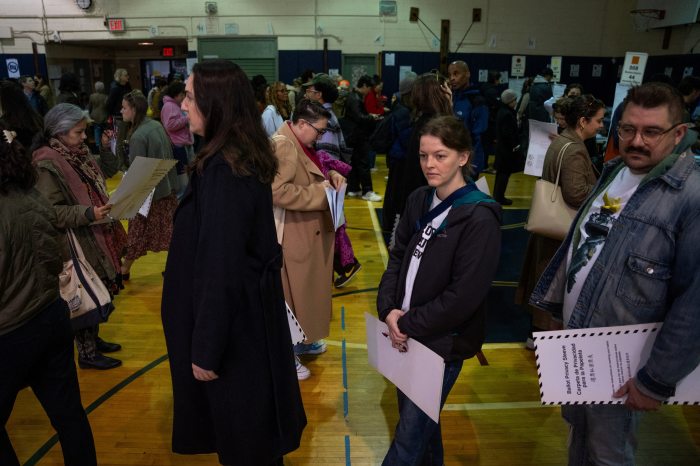
Voters at a polling site in Brooklyn on Tuesday. Angelina Katsanis/Reuters
Now Mamdani, a self-described democratic socialist, will be the one to lead the U.S.’s most economically important city as fiscal crises loom and President Trump threatens to withhold money and send National Guard troops to quell crime.
Cuomo will be forced to watch from the sidelines. Before he jumped in the mayor’s race, New York’s Democratic ex-governor was working as a private consultant in his own firm, Innovation Strategies, and earned $5 million in 2024. Cuomo hasn’t disclosed his clients, but the prospect of more high-paying consulting work remains even with his mayoral defeat, said George Arzt, a Democratic political consultant and onetime press secretary to former Mayor Ed Koch.
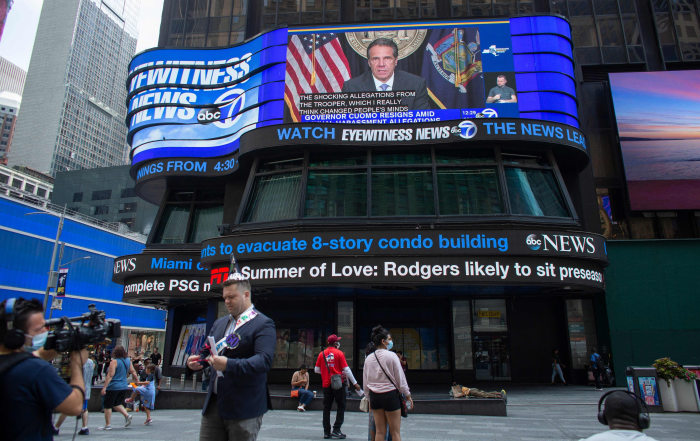
Andrew Cuomo resigned as New York’s governor in 2021. kena betancur/AFP/Getty Images
Yet consulting work is unlikely to assuage Cuomo’s hunger for redemption, which was a constant undercurrent in the mayor’s race. Forced to resign as governor in 2021 following sexual harassment allegations that he has denied, Cuomo viewed his mayoral bid as a political comeback for himself, and the family name.
A ‘Rose Garden’ campaign
Initially, the signs were promising. Since Cuomo had never enjoyed kissing babies and shaking hands, he tapped an adviser and Mercury Public Affairs partner Charlie King to oversee something of a plug-and-play campaign, using their consultants as staffers, starting in early 2025, according to multiple people with direct knowledge of the campaign. Cuomo made few public appearances at vetted events, while shoring up behind-the-scenes endorsements and party support. There were days when he canceled all events with little notice.
For the first quarter of the year, polling showed that Cuomo was the runaway favorite, and he acted like the front-runner—confident but cautious, staying above the fray. Cuomo viewed Mamdani as a longshot candidate who would be easily dispatched in a primary showdown, according to two of the sources. Instead of going on the attack, he released a plodding 17-minute video that sounded more like a State of the State address than a zingy stump speech.
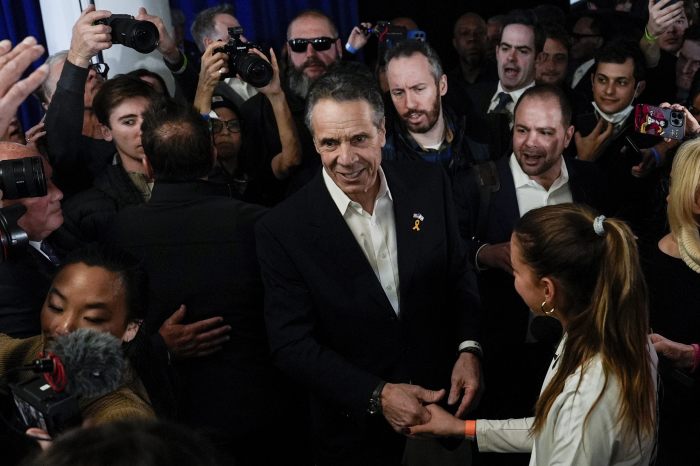
Andrew Cuomo campaigning in March. Julia Demaree Nikhinson/AP
Around May, polls shifted. Some voters showed a clear warmth for Mamdani, a relatively unknown Queens Assemblyman who turned 34-years-old in October. Melissa DeRosa, Cuomo’s longtime adviser, dismissed these polls internally, but the campaign would soon be preparing opposition research on the candidate, trawling through old videos, including his youthful time as a rapper.
But the primary campaign didn’t pivot. Cuomo talked often about Israel to contrast himself with Mamdani, but that message didn’t resonate widely. The Mercury team was seen as inexperienced by more seasoned political operatives, and would report optimistic field data even in the face of Mamdani’s surging popularity. The plan to grab the ring with a late surge in older Jewish and Black voters never fully materialized.
No concession speech
At the June primary, reality brought Cuomo’s comeback crashing to earth. Mamdani, the upstart candidate barely projected to make a dent in the results just a few months before, surged to the lead and was declared the winner with dizzying speed. A stunned Cuomo had to scramble for a concession speech. He didn’t have one ready to go.
Surrounded by campaign staffers at what was to have been a rousing victory party, Cuomo found a quiet place and got on the phone with Chris Coffey, an old Bloomberg administration hand and chief executive of Tusk Strategies, who was an unpaid senior adviser to the campaign during the primary. Coffey, who was then in San Francisco, and Cuomo worked out a concession speech, according to three campaign people with direct knowledge of the event. Coffey was also the only person in the campaign’s upper tier who had reached out to people close to Mamdani to get the candidate’s number, two of the people said.
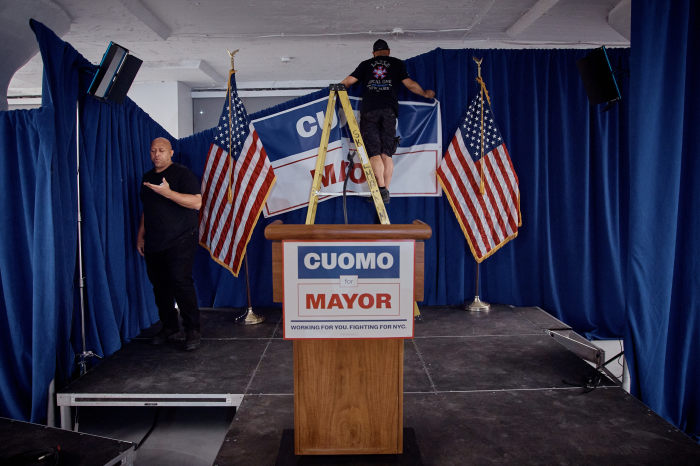
Workers at a party for Andrew Cuomo for the Democratic primary in June. Andres Kudacki/Getty Images
On Tuesday, a spokesman for Cuomo confirmed the two men spoke but said Coffey didn’t write the speech.
The harsh loss sent Cuomo into a tailspin, the people said. Immediately after, it was unclear if he would end his campaign. But in a few weeks’ time, after polls showed he still had a chance, he decided to dial back in. He opted to stay in the race as an independent, securing his place on the general election ballot.
A ‘new’ Cuomo
Over the summer, the campaign strategized to create a new Cuomo. He would be out and about, making appearances, pressing a case to older voters for an alternative vision for New York City. He would also aim to consolidate the field by pushing out rivals to Mamdani’s right. That included the sitting mayor, Eric Adams, and the Republican nominee, Curtis Sliwa.
By some measures, the effort almost immediately fizzled. Cuomo, 67, was more visible than he was before, showing up to more campaign events and meeting voters, but he ignored advice from staffers to provide a positive message that would contrast with Mamdani’s focus on affordability. For two weeks in September, one of Cuomo’s longtime confidantes and spokesmen, Rich Azzopardi, went on a vacation in Europe, four people said. Azzopardi said he worked the entire time he was away.
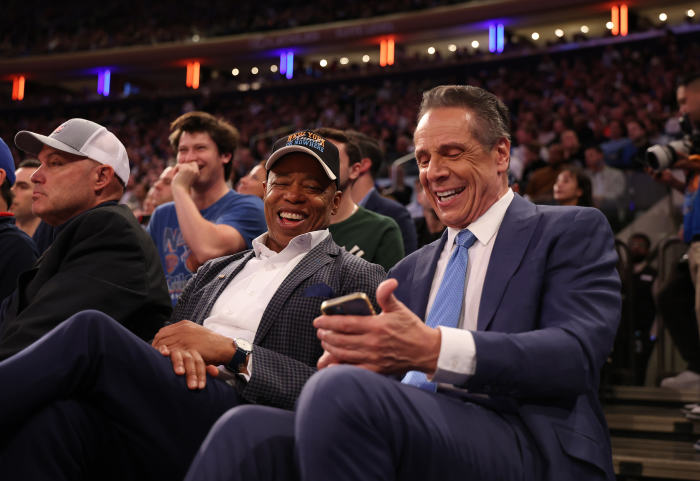
Mayor Eric Adams attended a Knicks game with Andrew Cuomo last month. Al Bello/Getty Images
Instead, Cuomo appeared to be most animated by the kind of backroom political sausage-making most voters don’t see. “We really needed compression in the race,” said Greg Goldner, the campaign manager for Cuomo during the general election. “Eric Adams dropping out was a significant factor in our growth in the electorate.”
SHARE YOUR THOUGHTS
What do you think Cuomo’s political future holds? Join the conversation below.
In late summer, Cuomo frequently called Frank Carone, the former chief of staff for Adams, to discuss what would be needed for the mayor to drop out of the race, said one of the former staffers. Adams ultimately dropped out in late September. Carone briefed Cuomo on job offers Adams received, including what looked promising and what was falling apart, the former staffer said.
Carone confirmed that he and Cuomo talked often during that time. When asked if any of those conversations included discussions of job offers from others, he said “it may have.”
Lackluster support
During the nine days of early voting, the electorate tilted consistently toward Mamdani. Cuomo, who started his political career in 1977 as a teenage adviser to his father Mario Cuomo’s losing bid for New York City mayor, seemed poised to end it in a similar doomed race. He reminded supporters Tuesday night that with 42% of the vote, he came in “just higher” than his father’s mayoral result nearly five decades ago.
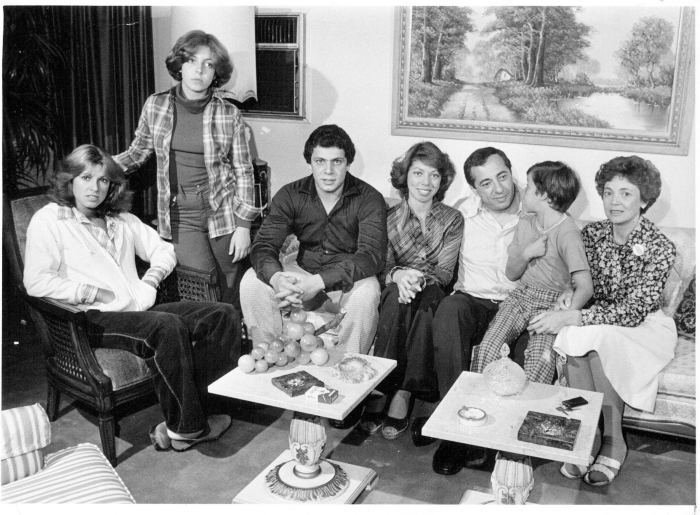
Andrew Cuomo, in dark shirt, with family members in 1977. George Argeroplos/Newsday RM/Getty Images
Mamdani locked down young voters during the primary, and he began picking up support from more moderate Black and Hispanic voters during the general election, said Roth Smith of Slingshot Strategies. Cuomo turned to independent voters and even hoped to peel off Republicans who were supporting Sliwa.
Appealing to Republicans was always going to be tough for Cuomo, said Roth Smith. They viewed him as the leader of the Democratic Party who resigned after a sex harassment scandal. Republicans also disliked him for how he handled the Covid-19 pandemic.
“You can’t undo that in the span of six months,” Roth Smith said.
Write to Kevin T. Dugan at kevin.dugan@wsj.com and Joseph De Avila at joseph.deavila@wsj.com
View this Wall Street Journal article CLICK HERE
 Media Air Base, LLC
Leave a comment