Global stock rout deepens as $500bn wiped off AI chip makers
Chris Price Markets Editor
Last updated 05 November 2025 10:23am GMT
Key moments
Asian markets plunge in stock sell-offAround $500bn (£384bn) was wiped off the value of semiconductor chip makers as a global stock market rout deepenedBig Tech skews stock marketAnalysts have warned that investors have become too heavily ‘concentrated’ in Big Tech companiesUK stocks slump at the openThe FTSE 100 fell at the start of trading but was shielded from the worst of the sell-off that has gripped global peers
The global rout in stock markets deepened as more than $500bn (£384bn) was wiped off the value of artificial intelligence (AI) chip makers.
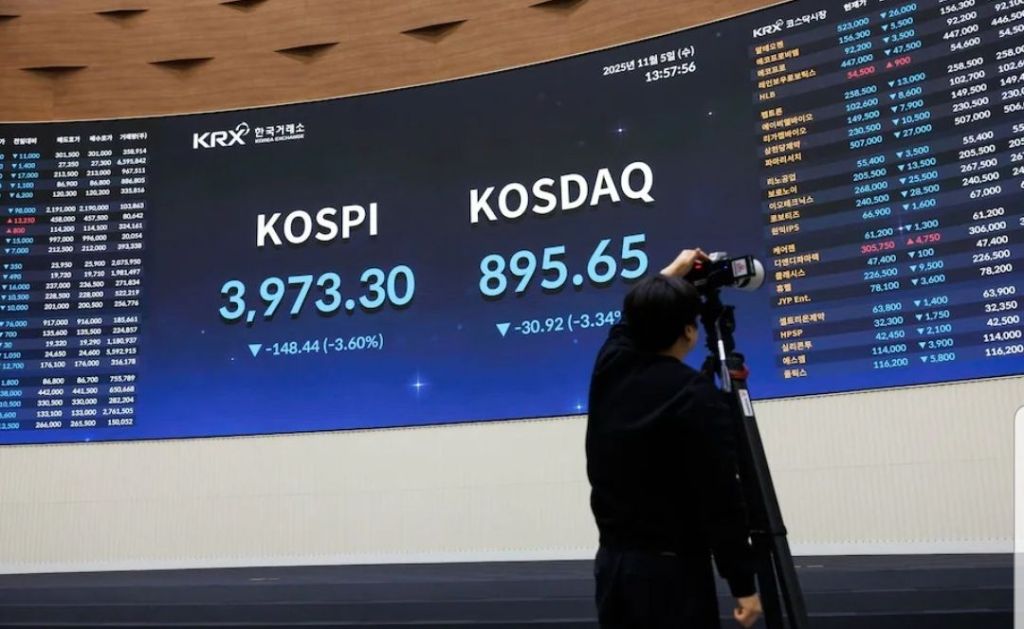
South Korean shares sank by as much as 6.2pc while Japan’s benchmark stock index tumbled more than 4pc at one point. MSCI’s main index of Asia-Pacific shares outside Japan was down as much as 2.3pc, which was the most since Donald Trump’s “liberation day” tariff onslaught in April.
Nvidia supplier Advantest dropped as much as 10pc, while Taiwan Semiconductor Manufacturing Co (TSMC) fell more than 3pc. The moves helped wipe around $500bn from two key indexes tracking semiconductor stocks.
Indexes recovered some ground this morning, as the Nikkei in Tokyo recovered to close 2.5pc lower and South Korea’s Kospi ended the day down 2.9pc. The FTSE 100 was down 0.1pc while French and German shares were down around 0.6pc.
Stocks retreated from record highs after key figures on Wall Street appeared to question the valuations of stock markets.
The bosses of Goldman Sachs and Morgan Stanley both suggested a correction was imminent over the next one to two years. Meanwhile it emerged that, Michael Burry, the investor depicted in The Big Short who bet against the housing market ahead of the global financial crisis, had placed heavy positions against Palantir and Nvidia.
Palantir sank nearly 8pc on Tuesday after its projections in its third quarter results failed to impress investors.
Chris Weston, head of research at Pepperstone Group, said: “It’s a sea of red across broad markets, and one that offers a gloomy and damp portrayal of risk.
“We need to remain open-minded to the possibility that this could still further build. Simplistically, there aren’t many reasons to buy here.”
Indices UK World Forex
| Name | Last | + / – % |
|---|---|---|
| FTSE 100 | 9700.46 | -0.15% |
| FTSE 250 | 21972.76 | -0.10% |
| All Share | 5226.2 | -0.15% |
| SmallCap | 7320.98 | -0.26% |
| AIM | 757.34 | -0.29% |
Wall Street lacks direction as China suspends US tariffs
US stocks were mixed in premarket trading after China said it would extend a suspension of additional tariffs on US goods for one year.
The Dow Jones Industrial Average was flat while the S&P 500 and Nasdaq were down 0.2pc to 0.3pc as Beijing formalised the agreement reached in talks between presidents Xi Jinping and Donald Trump last week.
The two leaders held talks in South Korea at the end of October that effectively prolonged a delicate truce for a year, after several rounds of trade negotiations in recent months.
A statement published Wednesday on the Ministry of Finance website, citing Beijing’s State Council, said that “for one year the 24 percent tariff on US goods will continue to be suspended, (and) a 10 percent tariff on US goods will remain”.
The statement said the pause follows “the consensus reached in the China-US economic and trade consultations” and would be effective from November 10.
Mr Trump on Tuesday formalised an agreement that Washington would cut its additional tariffs on Chinese imports from 20pc to 10pc, also effective from November 10.
House prices to flatline until next election, warns estate agent
House prices are set to flatline across Britain until 2028 as high interest rates and tax rise fears dampen buyer demand, Savills has warned.
Average prices adjusted for inflation will not return to growth until 2028, the estate agent said, bringing an end to stagnating values for the first time since 2022 in the wake of the pandemic.
Savills said the housing market continues to bear the brunt of weaker buyer confidence and concerns about the economy and taxation, slowing down demand into early 2026.
UK’s dominant industry most upbeat in a year
Bosses in the major driving force of Britain’s economy said they were the most upbeat about the next 12 months since October last year, a closely watched survey showed.
Business activity in the services sector expanded for the sixth consecutive month in October, according to the S&P Global UK Services PMI.
Its reading of 52.3 for October was better than an earlier “flash” reading of 51.1. A score above 50 indicates the sector is expanding, while below shows contraction.
Tim Moore, economics director at S&P Global, said: “The latest survey offered some positive signals for the UK service economy, with output growth stronger than the earlier ‘flash’ estimate for October, and therefore confirming a notable improvement from September’s five-month low.
“Similarly, the rate of new business expansion gained momentum, with the latest upturn among the strongest seen over the past year.”
Pound rebounds after investors scramble for safety
The value of the pound has recovered some ground after a double blow from Rachel Reeves’s tax warning and a flight to safety from investors.
Sterling was up 0.2pc to $1.305 after dropping as low as $1.301 overnight as investors dumped stocks and sought out the safe haven dollar.
The pound had already been hit on Tuesday by the Chancellor’s suggestion she would raise taxes in the Budget later this month to shore up the public finances.
It continued to be pushed downward by the sell-off in stocks that has gripped global indexes. Sterling was last up 0.1pc against the euro, which is worth just over 88p.
Stephen Innes of SPI Asset Management said: “Markets this week feel like a high-wire act above a canyon of complacency.
“Equity valuations have climbed so far out over the safety net that even a tremor in sentiment sends traders scrambling for the dollar’s embrace.
“There’s no single villain in this drawdown—just the collective recognition that prices were hovering near the stratosphere.”
European shares swept up in tech sell-off
European shares hit a two-week low as investors sold stocks over concerns that valuations have become too high.
The continent-wide Stoxx 600 fell 0.3pc to 568.94 as technology stocks sank as much as 1.8pc.
The Cac 40 in Paris was down 0.2pc while the Dax in Frankfurt declined by 0.6pc.
Novo Nordisk shares fell as much as 4.8pc but were last down 0.2pc in choppy trading. The Wegovy maker lowered its full-year profit forecast in an early blow to the Danish drugmaker’s new chief executive amid a deep restructuring drive.
Ambu slumped 12pc after the Danish endoscopy solutions maker reported quarterly results below consensus Vestas reported third-quarter operating profit above expectations, sending shares of the wind turbine maker up 10pc.
Bitcoin slumps amid $45bn exodus
Bitcoin dipped below $100,000 for the first time since June overnight as a $45bn (£34.5bn) exodus from the world’s largest cryptocurrency continued.
The digital token recovered slightly this morning to just over $101,000 but it remains down around 20pc from its record high above $126,000 last month.
Markus Thielen, head of 10x Research, said long-time holders of Bitcoin had offloaded around $45bn worth of the coin over the last month.
CoinGlass said around $2bn in crypto positions were liquidated over the past 24 hours.
UK stocks slump at the open
The FTSE 100 fell at the open but was shielded from the worst of the sell-off that has gripped global peers.
The UK’s flagship stock index was down just 0.3pc to 9,681.89 as its low exposure to tech protected it from the sharp downturn this week.
The domestically focused FTSE 250 was down 0.7pc to 21,948.58 amid concerns that Chancellor Rachel Reeves will dampen growth with an income tax rise in the Budget later this month.
OpenAI’s biggest backer hit by share rout
One of OpenAI’s biggest investors has been rocked by a rout of stocks exposed to the artificial intelligence (AI) boom as investors grow nervous over sky-high valuations.
SoftBank, the Japanese technology business, is set to become the ChatGPT developer’s biggest financial backer and has emerged as something of a proxy for the AI infrastructure boom thanks to its sprawling investments.
It has pledged to invest $30bn in OpenAI and last week approved a tranche of funding worth $22bn. It is also a substantial investor in Nvidia, Oracle and TSMC, and has promised to develop “Project Stargate” – a global data centre megaproject – with OpenAI.
Its shares had climbed almost 190pc this year on the AI rally. But overnight, SoftBank shares slid 10pc – and are down 16pc so far this week – as investors sold out amid concerns about a correction in tech stocks.
The shock drop came even as SoftBank chief executive Masayoshi Son and OpenAI’s Sam Altman unveiled a new partnership this morning which they claimed would transform how businesses use AI.
“Together with OpenAI, we’re driving the AI revolution to the next stage,” Son said.
Stocks fall after Big Tech races ahead of market
Stocks have slumped after markets became too heavily “concentrated” towards Big Tech stocks, analysts have warned.
The so-called Magnificent Seven group of stocks, which includes Nvidia, Microsoft and Tesla, has climbed around 45pc in the last year amid the excitement around the potential of artificial intelligence.
However, the S&P 500 has risen just 5pc over the same period when stocks on the index are equal weighted.
Jim Reid, an analyst at Deutsche Bank, said: “Whilst the moves were only one day’s sell-off, the market narrative saw a discernible shift, with a growing chorus discussing whether we might be on the verge of an equity correction.
“That speculation has gathered pace over the last month in particular, mainly because the Magnificent Seven has diverged from the rest of the S&P 500, which has revived questions about how concentrated this equity market now is.”
FTSE on track to fall at open
The UK’s stock market is on track to fall at the open amid the global sell-off in stocks.
The FTSE 100 was down 0.2pc in premarket trading, declining much less than other indexes due to its low exposure to tech stocks.
Meanwhile, the Cac 40 in France and Dax in Germany were on track to open lower by 0.6pc.
Marks & Spencer shares will be under scrutiny at the open after it revealed its half-year profits have more than halved following a major cyber attack earlier this year.
The retail giant reported underlying pre-tax profits of £184.1m for the six months to September 27, down 55.4pc from £413.1m a year earlier.
On a reported basis, profits were almost wiped out, plunging to £3.4m from £391.9m a year ago.
M&S said the cost of the attack is set to total around £136m, including about another £34m in the final six months, but it was able to recover £100m in its first half through an insurance payout for the hack.
SoftBank plunges amid AI investment fears
SoftBank Group, one of the world’s biggest tech sector investors, was one of the worst hit companies by the AI sell-off.
The majority backer of Cambridge microchip designer Arm dived as much as 14.3pc as investors questioned how the downturn would affect investment in the sector.
SoftBank is one of the major backers of OpenAI, the maker of ChatGPT, and is considered a proxy for the health of the sector.
Fawad Razaqzada, an analyst at Forex.com, said: “One concern here is that the leadership has become worryingly narrow, with a handful of mega-cap tech names doing all the heavy lifting, leaving the broader market vulnerable to any wobble in the AI narrative.”
Stocks ‘ripe for pull-back’
No single catalyst has been blamed for the tech stock sell-off, which has reached far and wide.
Despite strong earnings releases in recent quarters, traders have started questioning the wisdom of chasing ever-higher prices, with cash mostly funnelled into a handful of big-name companies.
Palantir, which has climbed 400pc over the last year, fell nearly 8pc on Tuesday even though its third quarter results beat expectations.
Matt Maley, chief market strategist at Miller Tabak, said the stock market was “ripe for some sort of material pull-back over the near-term”.
Charu Chanana, an analyst at Saxo Markets in Singapore, said: “A pull-back was overdue after strong and steady gains in tech.
“A firmer dollar, weaker crypto markets, and valuation concerns in US Big Tech have all combined to pressure risk sentiment.”
Good morning
Thanks for joining me. Around $500bn (£384bn) was wiped off the value of semiconductor chip makers as a global stock market rout deepened. Here is what you need to know.
5 things to start your day
1. Number of disabled young people doubles in 12 years | Mental health conditions including anxiety and depression are fuelling rise in benefits claim
2. Raise income tax by 10p for top earners to plug black hole, say economists | Think tank suggests Reeves should break manifesto pledges to show markets she has ‘a credible plan’
3. House prices to flatline until next election, warns estate agent | Savills says high interest rates and rise in unemployment are dampening buyer demand
4. World’s largest wealth fund rejects Musk’s $1tn payout | Norges Bank Investment Management becomes first major Tesla shareholder to oppose the deal
5. On the frontline of America’s car repossession boom | Number of seized vehicles hit 14-year high as more US drivers struggle to pay off auto loans
What happened overnight
Tokyo’s benchmark Nikkei 225 index dipped more than 4pc after a retreat on Wall Street spurred by selling of Big Tech shares.
Shares in energy and tech giant SoftBank Group sank 9.8pc on jitters over its investments in artificial intelligence. Computer chip maker Tokyo Electron dropped 4.1pc, while stock in Advantest, a maker of semiconductor testing equipment, lost 7.2pc.
South Korea’s Kospi declined as much as 6.2pc as Samsung Electronics shed 4.9pc. SK Hynix, which had logged major gains thanks to plans to develop artificial intelligence with chip maker Nvidia, lost 2.9pc.
Chinese markets were less affected. The Shanghai Composite index recovered from modest earlier losses to edge 0.2pc higher, to 3,967.53. Hong Kong’s Hang Seng declined 0.3pc to 25,888.16.
US stocks slumped on Tuesday over fears of an artificial intelligence bubble. The US benchmark S&P 500 closed down by 1.2pc. The tech-heavy Nasdaq Composite fell by 2pc while the Dow Jones Industrial Average was down by 0.5pc.
Cryptocurrencies, which typically move in lockstep with tech stocks, plunged, with the price of Bitcoin briefly falling below $100,000 for the first time since June. It is down more than 20pc since its record peak in October.
Weaknesses in the stock market drove investors to buy government bonds. Treasury yields dipped by a few basis points. The rate on 10-year Treasuries was 4.08pc.
Higher demand for US debt pushed up the value of the dollar to its strongest level since May.
View this Telegraph article CLICK HERE
 Media Air Base, LLC
Leave a comment