China Premier Says Economy to Surpass $23.9 Trillion in Five Years
In this Article
USDCNY Spot Exchange Rate – Price of 1 USD in CNY
Provide news feedback or report an error
By Bloomberg News
November 4, 2025 at 10:33 PM EST
Updated on
Takeaways by Bloomberg AIHide
- Chinese Premier Li Qiang suggested his country’s economy will maintain its current growth pace, touting China as an attractive market for global companies.
- Li said gross domestic product is expected to surpass 170 trillion yuan in five years, implying an average annual growth rate of about 4% through 2030.
- China will focus on “expanding domestic demand, especially on boosting consumption” to unleash the potential of the market and mitigate concerns over its trade imbalances.
Chinese Premier Li Qiang suggested his country’s economy will maintain its current growth pace, touting China as an attractive market for global companies as Beijing seeks to mitigate concerns over its trade imbalances.
Li said gross domestic product is expected to surpass 170 trillion yuan ($23.9 trillion) in five years, implying an average annual growth rate of about 4% through 2030 without adjusting for price changes. That’s in line with the nominal GDP growth reported so far this year.
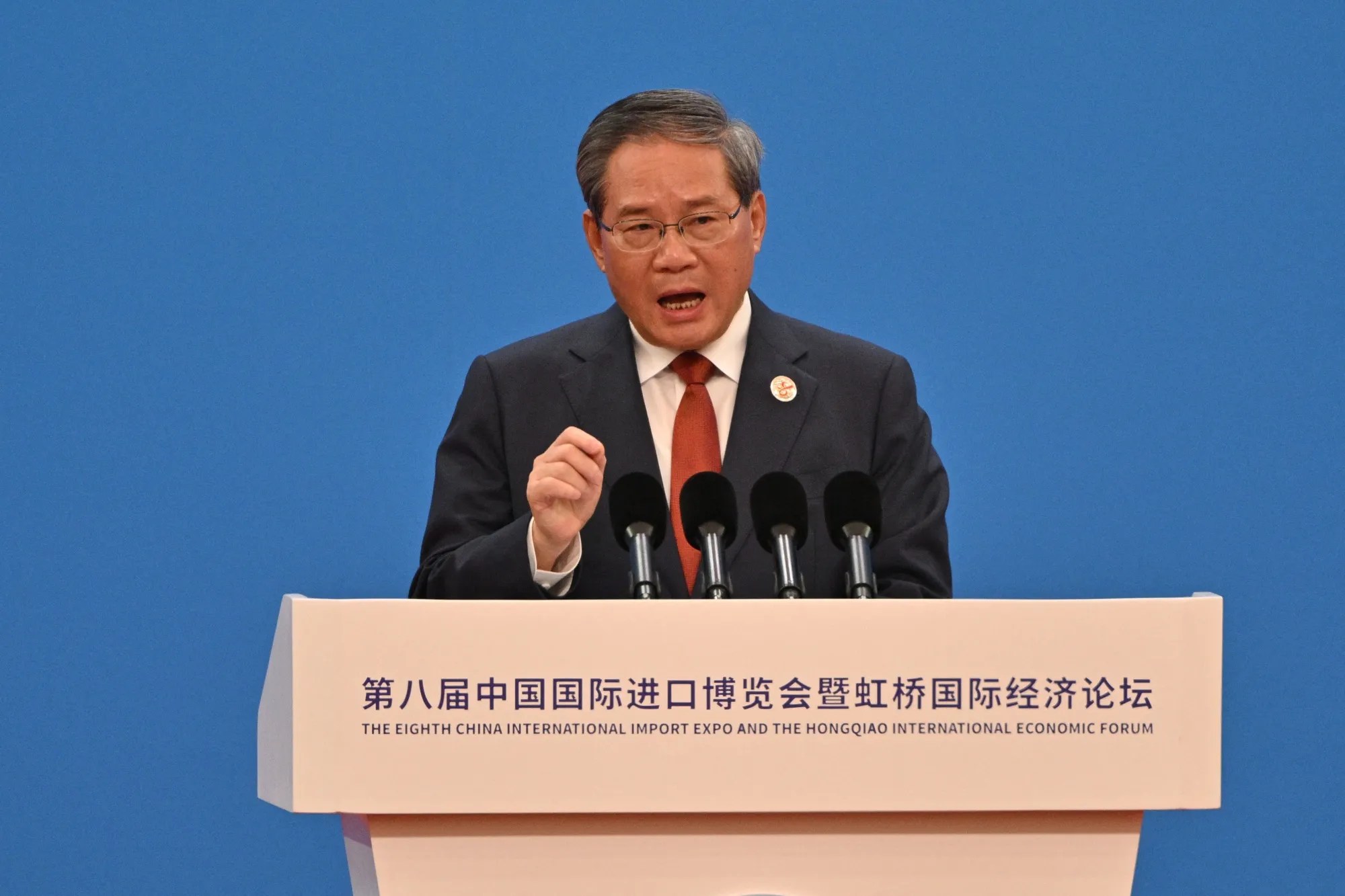
The increase represents “new significant contributions to global growth,” Li told government and business leaders gathered at the annual China International Import Expo in Shanghai on Wednesday. He stressed that China would focus on “expanding domestic demand, especially on boosting consumption” to unleash the potential of the market.
Chinese Premier Li Qiang reaffirms plans to boost the economy and lure investors during a speech at a trade event in Shanghai.
While Li wasn’t giving a precise target, the figure can be seen as a growth floor and reflects officials’ increasing focus on the quality of expansion, according to Michelle Lam, Greater China economist at Societe Generale SA.
“The number shows nominal GDP growth won’t go further down from here onwards,” she said. “At the end of the day, the priority is no longer about the quantity of real GDP. Escaping deflation is more important.”
Zhaopeng Xing, senior strategist at Australia & New Zealand Banking Group, said surpassing 170 trillion yuan could mean anything between 170 trillion yuan and 180 trillion yuan, which would represent a “reasonable” range of nominal GDP growth from 4% to 5% annually.
China is on track to achieve its real GDP growth goal of about 5% this year, but nominal expansion has been slower due to falling prices. Persistent deflation is toxic for growth because it encourages consumers to delay purchases, increases debt burden and squeezes profit margins, risking a downward spiral of weaker spending and lower investment.
Read More: China’s Deflationary Spiral Is Now Entering Dangerous New Stage
Breaking this cycle has become a top policy priority. Beijing has launched a so-called “anti-involution” campaign, an effort to stamp out the price wars that have plagued industries from electric vehicles to food delivery. By cracking down on excessive competition, officials look to help firms restore pricing power, rebuild margins and ultimately create capacity for the wage growth needed to spur consumption.
Regardless of spending power, China’s appeal as a consumer market depends on more than its overall growth pace. The European Union and the US have long complained about Chinese trade practices that prevent fair competition, and rising trade protectionism has disrupted the business environment.
China’s Household Consumption Is Weak
Economist calls for increasing the share over the coming decade
Source: World Bank
Note: “High income” represents high-income countries. Figures for China, EU, world and high-income countries are for 2023. Japan figure is for 2022, and US figure is for 2024.
In a clear criticism of such trade barriers, Li said “unilateral and protectionist measures have had a severe impact on the international economic and trade order.”
He added that China will work with other countries to promote stable and unimpeded global industrial and supply chains. Georgian Prime Minister Irakli Kobakhidze and Serbian Prime Minister Duro Macut were among those in the audience.
These tensions were alleviated somewhat last week after Beijing and Washington sealed a trade truce in South Korea. US President Donald Trump and China’s Xi Jinping agreed to reduce tariffs and roll back export controls in a landmark summit that stabilized relations after months of escalation.
Read more: Here’s How US, China Statements Compare Post Xi-Trump Summit
The growing uncertainty abroad has also fed into China’s planning for the next half-decade, with Beijing last week pledging to “form an economic development model driven more by domestic demand and powered by consumption.”
The government plans to “significantly” boost consumption’s contribution to the economy and increase spending on public services and work on promoting employment, according to a readout laying out basic principles for the next five-year plan starting in 2026.
The new language signals growing resolve on the part of China’s policymakers to promote consumption among its 1.4 billion people, as countries around the world increasingly push back on its cheap goods flooding global markets.
Read More: Trump’s Tariffs Unleash a New ‘China Shock’ on Rest of World
(Updates with more context, comments.)
View this Bloomberg article CLICK HERE
 Media Air Base, LLC
Leave a comment