Stocks tend to suffer in the second half of September — but the Fed’s rate cut might keep bears at bay
Stocks have been on a slow, steady grind higher amid a controlled market environment with little sign of complacency, says one strategist
By Isabel Wang
Published: Sept. 19, 2025 at 5:00 p.m. ET

History suggests it could be a downhill ride for stocks through the end of September.Photo: Getty Images
Referenced Symbols
Wall Street breathed a sigh of relief this week after the Federal Reserve decided to cut interest rates for the first time in 2025 — with markets flipping the switch back to risk-on, and cheering as if the rally will never end.
But history suggests a hangover could arrive in the back half of this month.
See: September is historically the worst month of the year for stocks. Why this time could be different.
Historically, stock-market performance in September has been bifurcated between the first and second halves of the month, according to LPL Financial. Stocks have typically traded sideways or slightly positive during the first half of September, while the second half usually sees “a downhill ride” for equities into month-end, said Adam Turnquist, chief technical strategist at LPL Financial (see chart below).
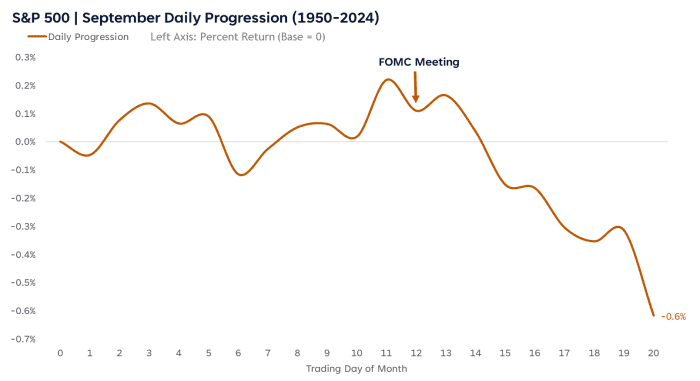
SOURCE: LPL RESEARCH, BLOOMBERG
U.S. stocks have staged a record-setting rally this month, with the S&P 500
surging more than 3% and the Nasdaq Composite
up nearly 5.5% so far in September, according to Dow Jones Market Data — bucking the month’s notorious reputation as the market’s weakest stretch of the year
That’s mainly because September’s stock-market outlook has improved when factoring in macroeconomic momentum and market trends, according to analysts.
“With the FOMC meeting in the rearview, U.S. stocks are now on the other side of arguably the month’s largest risk event and trading near record highs,” Turnquist said in a client note on Thursday. “The lack of any hawkish surprises [on Wednesday from the Fed] and the restarting of the rate-cutting cycle could be enough to offset any seasonal headwinds and keep risk appetite on the table.”
Are markets too complacent?
To be sure, the usual Wall Street caution is that stocks at record levels are more exposed to market volatility due to their lofty valuations, so investors should be prepared for a period of consolidation or choppiness. Other indicators, however, suggest that stocks could continue to push even higher from here.
For one, investor sentiment has yet to show signs of extreme optimism, said Mark Hackett, chief market strategist at Nationwide.
The latest AAII Sentiment Survey showed that bullish sentiment — expectations that stock prices will rise over the next six months — stood at 41.7% in the week ending Thursday, while bearish sentiment was at 42.4%. Additionally, while bullish sentiment last week was above its historical average of 37.5% for the first time in seven weeks, bearish sentiment was still unusually high and was above its historical average of 31.0%.
CNN’s Fear & Greed Index — which aims to assess where investors are on a scale between being maximally fearful and maximally greedy — was at 62, or “greed” level, on Friday morning, rising slightly from “neutral” a week ago.
“If you look at CNN’s Fear & Greed, if you look at AAII sentiment being equal bull-to-bear, if you look at the flow trends that have seen a tremendous amount of money still going into money-market accounts and bonds — this is not the activity you see when stocks are at tops,” Hackett told MarketWatch in a phone interview on Friday.
Also see: This seasonal stock-market trading pattern is coming up — and worth observing
Since August, the stock market has largely defied bearish expectations, brushing aside weak seasonal patterns, a potential post-Fed dip and possible volatility following major economic-data releases. Instead, the three major stock indexes have been on “a slow, steady grind higher” each day, which is “a kind of death by a thousand paper cuts for the bears,” Hackett said.
“This feels like a really controlled market environment — one that we’re not seeing signs yet of complacency,” he added. “I’m starting to believe that all of the historical patterns that we rely on are being overwhelmed by this new phenomenon.”
U.S. stocks finished higher on Friday, with the three major indexes scoring fresh records and booking strong weekly gains. The Dow Jones Industrial Average
rose nearly 1.1% for the week, while the S&P 500 was up 1.2%, and the Nasdaq advanced 2.2%, according to FactSet data.
To continue with this MarketWatch article CLICK HERE
 Media Air Base, LLC
Leave a comment