Norman Fosback’s ‘Seasonality Timing System’ shifts in and out of stocks at the turn of every month
Article Provided by MarketWatch
By
Last Updated: March 23, 2025 at 3:58 p.m. ET
First Published: March 22, 2025 at 12:28 p.m. ET

Photo: Getty Images/iStock
Referenced Symbols
You can come close to matching the stock market’s return, and even have a good chance of beating it, while being in the safety of a money-market fund one-third of the time.
That seems too good to be true, since it violates a core principle of investing that in order to earn market-like returns, you must incur market-like risk. The Seasonality Timing System (STS) created by Norman Fosback in the 1970s is an exception to that rule.
Fosback at the time was the head of the Institute for Econometric Research. He based the STS on the calendar: Be in cash at all times except for the few days around the turns of the month and immediately prior to holidays when the stock market is closed.
Currently, for example, the STS has investors 100% in cash until March 27, after which you would remain fully invested in the U.S. stock market until April 7.
Fosback’s system has been successful because the market’s best and worst days don’t occur randomly. Instead they tend to follow a calendar-based rhythm. This year provides a good illustration. Of the 10 trading sessions since New Year’s in which the S&P 500
rose the most, eight occurred during the handful of days in which the STS system was invested in the stock market. In contrast, Fosback’s system was in cash on five of the 10 days this year with the worst returns.
Now Playing: Educating Clients About Finance to Ensure Successful Retirements
Investors following the timing system so far this year have enjoyed a significant advantage. Through March 19 the system produced a 0.3% year-to-date loss, versus a 3.5% loss for buying and holding the broad market. Over the 40+ years that my auditing firm has tracked the STS, it is in first place for risk-adjusted performance among market timing services.
(Disclosure: At no point have any of Fosback’s newsletters been among those that pay a flat fee to have its returns calculated by my performance-auditing firm.)
A helpful analogy is to the phenomenal success of the Medallion Fund. This is the hedge fund managed by James Simons of Renaissance Technologies, which according to a 2020 article by UCLA Professor Bradford Cornell produced a compound return of 63.3% between 1988 and 2018. Though Simons is notoriously tight-lipped about how his fund produced this return, Gregory Zuckerman of the Wall Street Journal has reported that the Medallion Fund’s trades are profitable just 50.75% of the time.
Because the fund’s trades are extremely short-term, and the fund executes thousands of them every year, that seemingly modest success percentage is enough to produce its phenomenal long-term return.
Timing is everything
Unlike other market-beating strategies of the 1980s and 1990s, most of which stopped working after they became widely known and followed, the STS appears not to have lost its effectiveness. This is illustrated in the chart below, which plots the trailing five-year returns of two hypothetical portfolios — one for the STS and one for a buy-and-hold stock investment strategy.

MarketWatch Subscriber Message
Insider Deals for MarketWatch Subscribers
Subscribe to The Journal Collection to get the latest exclusive brand deals delivered to your inbox, included in your MarketWatch subscription.
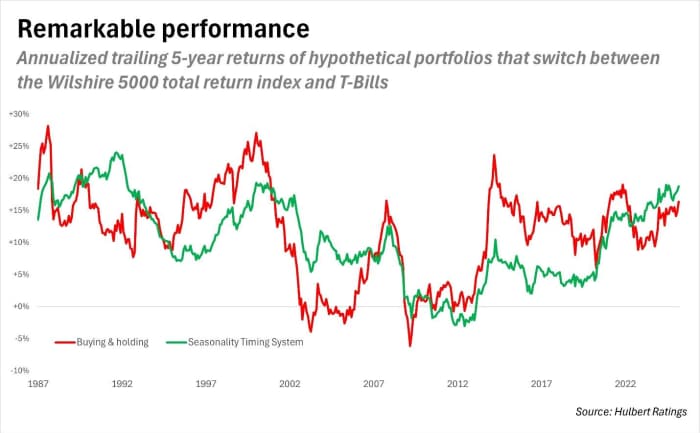
Notice that the STS closely matches the market over more than four decades, slightly outperforming over some five-year periods and slightly lagging in others. In the most recent five-year period, for example, the STS came out far ahead.
The system’s success is rooted in several factors. One is that a big chunk of investors’ retirement contributions flow into the stock market at the end of every month, as 401(k) amounts are debited from their monthly paychecks and are supplemented by employer matches. Another is that traders are reluctant to be short the market during the three-day stretches that occur in conjunction with exchange holidays, and therefore cover their shorts in advance.
Long-term strategy
This system is more appropriate for 401(k)s, IRA(s) and other tax-deferred accounts.
Even though the STS calls for many short-term trades, it is designed to be followed over the long term. Its advantage over buying and holding is likely to be quite modest over shorter periods. The frequency of the STS’s transactions also means that you shouldn’t implement this system in a taxable account. It’s more appropriate for 401(k)s, IRA(s) and other tax-deferred accounts.
Perhaps the most important factor to keep in mind as you consider whether to follow the STS is that it’s boring. You’ll be in cash well more than half the time, which could be intolerable if you’re addicted to the excitement and drama of the stock market’s short-term volatility. On the assumption the future will be like the past, however, you will be rewarded over the long term for tolerating that boredom.
Mark Hulbert is a regular contributor to MarketWatch. His Hulbert Ratings tracks investment newsletters that pay a flat fee to be audited. He can be reached at mark@hulbertratings.com
More: Ranking the S&P 500s most defensive stocks
Plus: Even Wall Street’s most committed bears expect a stock-market rebound
 Media Air Base, LLC
Leave a comment